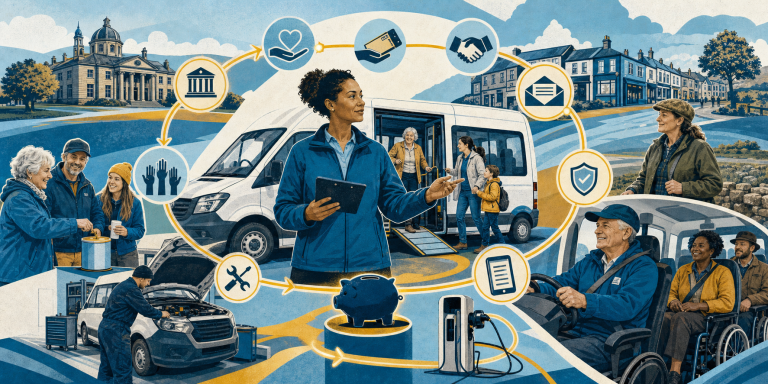



Volunteer drivers are the backbone of community transport. They take older and disabled people to hospital, to the GP, to the shops and to see friends, often in their own cars and for nothing more than their mileage. Without them, thousands of journeys a week across the UK simply would not happen.
This guide is for two groups. If you are wondering how to become a volunteer driver, it explains what the role involves, what checks you need and what you can claim. If you run a scheme, it covers how to grow your volunteer drivers, how to keep them and what the rules say about expenses, insurance and minibuses.
Key Takeaways
- Volunteer drivers are in short supply. 67% of community transport operators in England say they do not have enough volunteers to meet demand (CTA).
- Drivers can claim up to 55p a mile tax free for the first 10,000 miles from 6 April 2026, then 25p a mile (HMRC).
- DBS checks are free for eligible volunteers, and most insurers cover volunteer driving at no extra cost if payments stay within HMRC rates (ABI).
- Drivers who passed their test from 1 January 1997 can drive a permit minibus only under set conditions, including being unpaid and aged 21 or over (DfT).
- Schemes keep drivers by offering flexible availability, fast expenses, nearby jobs and real thanks, and by cutting the admin that wears volunteers down.

What does a volunteer driver do?
A volunteer driver gives lifts to people who cannot easily drive or use public transport. Most use their own car through a community car scheme, and claim a mileage rate to cover their costs. Others drive a charity's accessible minibus for Dial-a-Ride, day centres or group trips, usually under a Section 19 or Section 22 permit.
The journeys vary. Many are to hospital and GP appointments, which our guide to volunteer transport to hospital covers in detail. Others are to shops, lunch clubs, day centres and family. Drivers often help passengers in and out of the car, carry bags and wait during appointments.
For many passengers, the driver is the only person they will talk to that day. That makes the role as much about kindness and patience as it is about driving. It is also why schemes look for reliable, friendly people more than for any particular background or skill.
Why are volunteer drivers in short supply?
Demand is rising faster than the volunteer base. The Community Transport Association estimates nearly 16,000 volunteers support its members in England. Even so, 67% of operators said they did not have enough volunteers to meet demand, and 37% saw recruitment fall in the past year (CTA Mapping England).
Volunteering overall has dropped too. The Community Life Survey 2024 to 2025 found 17% of adults in England volunteered formally at least once a month, down from 23% in 2019 to 2020. The most common barrier was work commitments, named by 51% of people who did not volunteer.
Minibus driving faces its own squeeze. Drivers who passed their test before 1997 hold D1 minibus entitlement automatically, and the CTA expects their number to fall by a fifth within five years. Younger drivers can still drive a permit minibus, but only under stricter conditions, which we explain below.
How do you become a volunteer driver?
Becoming a volunteer driver is usually straightforward. Most schemes want people who are reliable, patient and happy to help, with a clean or reasonable driving record. The process normally takes a few weeks from first contact to first journey, mainly while checks come back. It usually follows these steps:
- Find a local scheme. Use the Community Transport Association map, search your council's website, or ask your GP surgery or a local volunteer centre.
- Apply and chat. Most schemes hold an informal conversation about your availability, where you live and the kind of journeys you would like to do.
- Complete your checks. Expect a DBS check, a driving licence check and proof of your MOT and insurance.
- Take an induction. This covers safeguarding, helping passengers, confidentiality and how bookings and expenses work.
- Start driving. Many schemes pair new drivers with experienced ones, or start them on shorter, simpler trips.
You choose how much you give. Some volunteers drive once a month, others several times a week. Good schemes let you set your own availability and say no to a journey without any pressure, which matters if you work, care for someone or simply want to keep your weekends free.
What do volunteer drivers need?
Requirements vary between schemes, but most ask for the same core things. The table below shows what to expect if you drive your own car or a scheme's minibus. Always check the details with your local scheme, because insurers and funders sometimes add their own conditions.
| Requirement | Own car (car scheme) | Scheme minibus (permit) |
|---|---|---|
| Driving licence | Full UK car licence, often held for at least two years | Car licence held for two years, or D1 entitlement |
| Minimum age | Set by the scheme and its insurer | 21 or over |
| DBS check | Usually standard or enhanced, free for volunteers | Usually enhanced, free for volunteers |
| Insurance | Your own policy, with volunteer driving covered | The scheme's policy |
| Vehicle | Roadworthy, taxed and with a current MOT | Maintained by the scheme |
| Training | Induction and safeguarding | Induction, often MiDAS minibus training |
On DBS checks, the Disclosure and Barring Service provides standard and enhanced checks free of charge to volunteers who are unpaid apart from travel and approved expenses (DBS). Schemes carrying children or adults at risk usually need an enhanced check, and should recheck drivers regularly.
For minibus work, many operators use MiDAS, the Community Transport Association's minibus driver training scheme. Its partner course, PATS, trains passenger assistants to secure wheelchairs and support passengers safely. Both give drivers confidence and give schemes a clear standard to point to.
Do volunteer drivers get paid expenses?
Volunteer drivers are not paid for their time, but they can claim expenses. GOV.UK says volunteer expenses usually cover things like food, drink and travel, and that payments beyond genuine expenses could make someone a worker rather than a volunteer (GOV.UK). For drivers, that usually means a mileage rate.
HMRC's approved mileage rate for cars rose from 45p to 55p a mile for the first 10,000 miles, backdated to 6 April 2026. Above 10,000 miles it stays at 25p (HMRC). HMRC's volunteer guidance confirms that a driver who receives 55p a mile or less on their first 10,000 miles has no tax to pay (HMRC).
| Miles driven in the tax year | Tax free rate for cars |
|---|---|
| First 10,000 miles | Up to 55p a mile |
| Over 10,000 miles | Up to 25p a mile |
The 10,000 miles count across all the organisations you drive for, not each one. If a scheme pays more than these rates, the extra may be taxable. Our article on the HMRC mileage rate increase explains what the change means for fares, budgets and grant bids.
Do you need special car insurance to volunteer?
Usually not. Under the Association of British Insurers' volunteer driving commitment, the insurers who sign up agree to cover volunteer driving for charities and voluntary groups, as long as payments do not exceed HMRC mileage rates. Most do not charge an extra premium, and cover it under social, domestic and pleasure use (ABI).
There are a few things to check before your first journey:
- Tell your insurer if they ask you to. Many insurers require notice even though they do not charge more.
- Include your volunteer miles when you declare your annual mileage.
- Check your insurer has signed the ABI commitment. If not, you may need to pay extra for full cover.
- Check the scheme's own policy if you drive one of its vehicles rather than your own car.
Can volunteer drivers drive a minibus?
Yes, under a permit, but the rules depend on when you passed your test. All permit drivers must be 21 or over. Drivers who passed their car test before 1 January 1997 usually hold D1 entitlement and can drive a permit minibus of any weight (DfT permit guidance).
Drivers who passed from 1 January 1997 can still drive a permit minibus on a car licence, but only if they have held it for at least two years, receive nothing beyond out of pocket expenses, and the minibus weighs no more than 3.5 tonnes, or 4.25 tonnes with specialist equipment for disabled passengers.
Those conditions matter for recruitment. As the pre 1997 group retires, schemes will rely more on newer drivers and lighter vehicles. Our community transport guide explains the difference between Section 19 and Section 22 permits in more detail.
How can schemes recruit more volunteer drivers?
The best recruiters are specific. Instead of "volunteers needed", say "two hours on a Tuesday morning taking people to the local hospital". Clear, small asks feel doable. The Community Life Survey also shows who is most likely to say yes: 23% of people aged 65 to 74 volunteer monthly, well above the national average.
Ideas that work for many schemes:
- Ask your current drivers to bring a friend. Word of mouth is still the strongest recruiter.
- Target recent retirees through local clubs, churches, golf and bowls clubs, and retirement events run by large employers.
- Offer short, fixed commitments, such as one regular trip a week or a few hours a month, rather than open ended availability.
- Work with employers that give staff paid volunteering days. A regular Friday hospital run can suit a working volunteer.
- Tell passenger stories on social media and in parish magazines, with the passenger's permission. People volunteer for people, not for a vacancy.
- Be clear on money. State your mileage rate and how quickly you pay expenses in every advert.
If you are starting from nothing, our guide on how to set up a community car scheme covers the early decisions, from insurance to booking processes, before your first advert goes out.
How do you keep volunteer drivers?
Recruiting a driver takes weeks. Losing one can take a single bad experience. Volunteers rarely leave because of the passengers. They leave because of the things around the driving, such as late expense payments, confusing paperwork, calls at all hours and feeling taken for granted by the people who run the scheme.
The schemes that keep drivers for years tend to get these right:
- Respect availability. Let drivers set their own times and never make them feel guilty for turning a job down.
- Pay expenses quickly and at the current HMRC rate. Rising fuel costs make slow or low payments a real reason to quit.
- Offer nearby jobs. Matching drivers to passengers close to home cuts wasted miles and makes each trip easier.
- Cut the admin. Replace phone tag, paper run sheets and mileage forms with a simple app or clear weekly schedule.
- Support them. Give drivers a named contact, clear safeguarding steps and a debrief after a difficult journey.
- Say thank you. A card, a social evening or a mention in the newsletter costs little and means a lot.
Paper run sheets carry another risk. They hold passenger health and address details, which is special category data under UK GDPR. Our article on why paper run sheets are a data breach risk explains how to protect drivers and passengers at the same time.
What volunteer drivers mean for each role
Volunteer drivers touch nearly everyone involved in community transport. Here is what matters most to each group.
Coordinators and transport managers
Track how many requests you turn down for lack of drivers, not just the journeys you complete. That unmet demand is your strongest evidence for funders. Review expense payment times and driver numbers every month, so you spot a retention problem before your most reliable volunteers start drifting away.
Charity CEOs, trustees and board members
Trustees are responsible for driver checks, insurance, safeguarding and data protection. Ask for a simple dashboard showing DBS, licence, MOT and insurance expiry dates for every driver. Our guide to trustee liability sets out what boards should check each quarter.
Councils, NHS teams and public sector buyers
Volunteer car schemes carry many patients to appointments with little or no health funding. Paying a fair contribution towards coordination, mileage and training protects capacity you already rely on. The case for this is set out in our article on why community transport matters.
HR and people teams
Employer volunteering schemes are an underused source of drivers. Offering staff a few paid hours a month to drive for a local scheme builds goodwill, supports wellbeing and gives charities the regular weekday help they struggle to find. Check your company insurance and expenses policy covers it first.
Passengers, carers and families
Book as early as you can, because schemes plan around driver availability. Tell the scheme about wheelchairs, walking aids or a carer travelling with you. If a driver has made a difference, say so. A thank you passed on to the coordinator often keeps a volunteer going for another year.
Where Road XS fits
Road XS is community car scheme software built around volunteer drivers. It finds the nearest available driver with up to date checks, alerts coordinators before a DBS, licence, MOT or insurance lapses, and works out mileage claims automatically. Drivers see their jobs in a simple portal or app, with precise pickup points.
That tackles the retention problems above head on. Nearby jobs cut wasted miles, clear schedules replace phone tag, and expenses are calculated without paperwork. See how our volunteer driver scheduling software works, or talk to our team about your scheme.
Frequently asked questions
How do I become a volunteer driver?
Contact a local community transport scheme through the Community Transport Association map, your council or your GP surgery. After an informal chat, you will usually need a DBS check, a licence check and proof of MOT and insurance, followed by a short induction on safeguarding and bookings.
Do volunteer drivers get paid?
No. Volunteer drivers are not paid for their time, but they can claim expenses, usually a mileage rate. Payments above genuine expenses could make someone a worker rather than a volunteer, so most schemes stick to HMRC's approved mileage rates.
How much mileage can a volunteer driver claim tax free?
From 6 April 2026, volunteer drivers can receive up to 55p a mile tax free for the first 10,000 miles in a tax year, and 25p a mile after that. The 10,000 miles count across every organisation you drive for.
Do I need to tell my insurer I am a volunteer driver?
Often, yes. Insurers who have signed the ABI volunteer driving commitment cover volunteer driving, usually at no extra cost, if payments stay within HMRC rates. Many still ask you to tell them first, and you should include volunteer miles in your annual mileage.
Do volunteer drivers need a DBS check?
Most schemes require one, usually standard or enhanced depending on who you will carry. The Disclosure and Barring Service provides these checks free of charge to eligible volunteers who receive nothing beyond travel and approved expenses.
Can a volunteer drive a minibus on a car licence?
Yes, under a Section 19 or Section 22 permit, if they are 21 or over, have held a car licence for at least two years, are unpaid apart from expenses and the minibus weighs no more than 3.5 tonnes, or 4.25 tonnes with specialist disability equipment.
How can we recruit more volunteer drivers?
Make small, specific asks, target recent retirees and local groups, and ask current drivers to bring a friend. State your mileage rate clearly, pay expenses quickly and let volunteers set their own availability. Employer volunteering schemes can also provide regular weekday drivers.
Run a volunteer driver scheme and want to spend less time on phone calls and paperwork? Book a Road XS demo or talk to our team.