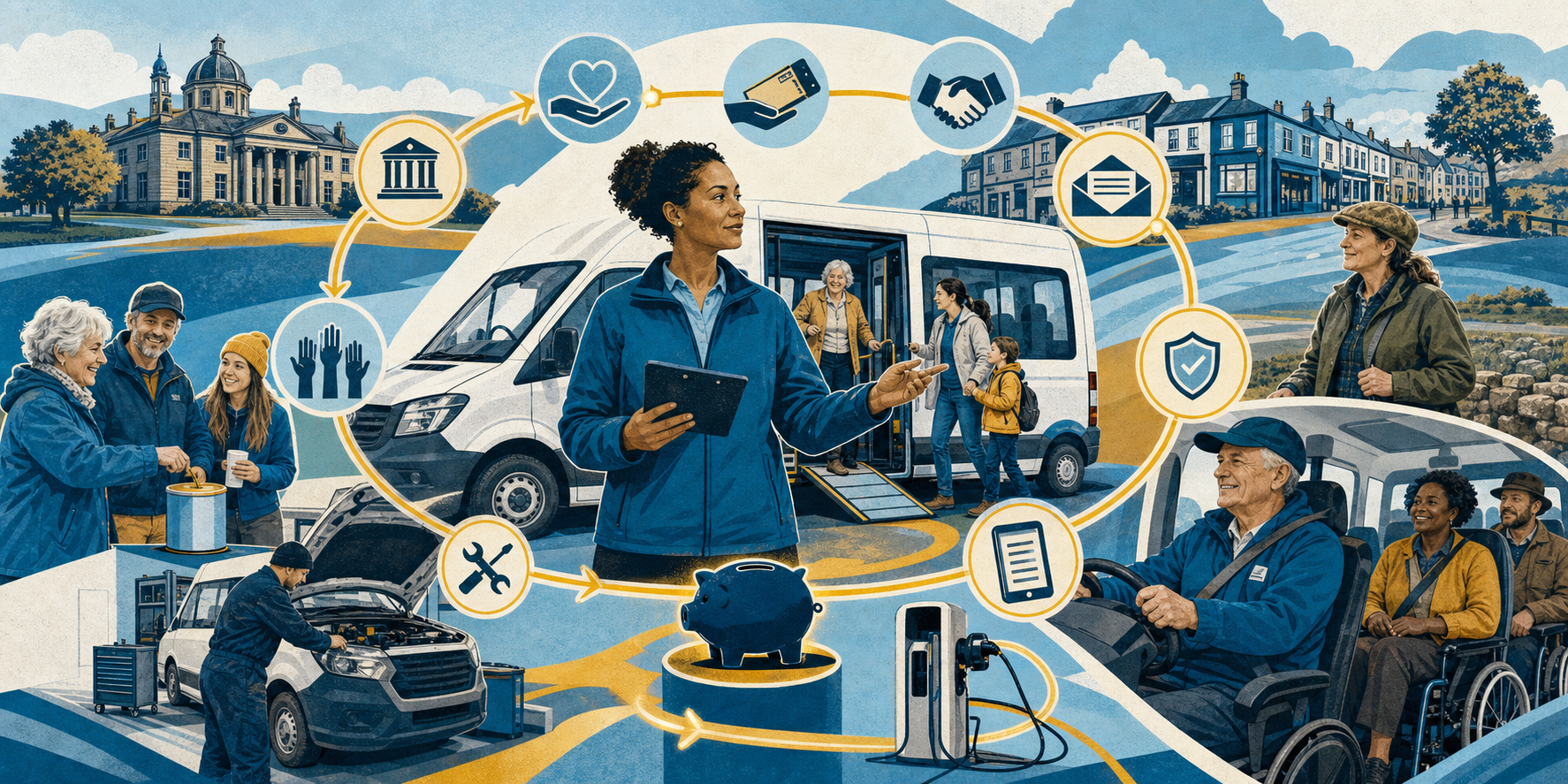
Community transport grant funding has just been through its biggest reset in a decade. In the space of six months, the two questions every coordinator asks, where does the money come from and what will funders pay for, have both changed their answers. The UK Shared Prosperity Fund has closed, three consolidated bus funding streams have replaced the old patchwork, and HMRC has raised the volunteer mileage rate for the first time in 15 years.
This playbook maps the grant funding streams open to community transport schemes in 2026. It then does the thing most funding guides skip. It shows you how to write software and technology into a bid so it strengthens the application instead of being the first line a panel strikes out.
It is written for trustees, coordinators and managers of community transport schemes, voluntary car schemes, Dial-a-Ride services and demand responsive transport operating under Section 19 or Section 22 permits, and for anyone writing a funding bid on their behalf. It is educational guidance rather than financial or legal advice, so always confirm current deadlines and criteria with the funder before applying.
Key Takeaways
- From 1 April 2026, government bus funding flows through three consolidated streams, with over £1 billion per year committed to 2028/29, and your local transport authority now receives a formula based allocation every year
- The Bus Services Act 2025 gives councils a duty to identify and protect socially necessary local services, which makes community transport part of how they meet a legal obligation, not just another grant applicant
- The Motability Foundation awarded over £14 million to 33 organisations between 2022 and 2025 and now names digital transformation in its published funding criteria
- HMRC raised the approved mileage rate from 45p to 55p per mile from 6 April 2026, which means every volunteer mileage budget written on the old rate now understates real costs
- Technology lines get cut from bids when they read as overheads; written as delivery costs tied to journeys and outcomes, they get funded
- Every funding stream asks for the same underlying evidence: journeys, passengers, outcomes and cost per journey, so schemes that capture this automatically win more, faster
What Changed in Community Transport Funding in April 2026?
On 1 April 2026, the Department for Transport replaced the old patchwork of short term competitive pots with three consolidated bus funding streams, backed by over £1 billion per year from 2025/26 through to 2028/29. At the same time, the UK Shared Prosperity Fund closed and two successor programmes opened.
The three streams matter to community transport in different ways. The Local Authority Bus Grant (LABG) is a single grant paid to every local transport authority in England outside London, allocated by a needs based formula rather than competition. It consolidates the old Bus Service Improvement Plan (BSIP) money and the local authority share of the Bus Service Operators Grant. This is the pot your council draws on when it runs a local community transport grant round.
The Bus Service Operators Grant (BSOG) is paid directly to commercial and community bus operators to offset fuel and running costs, either by the DfT or by the local authority where funding has been devolved. Many eligible community transport operators still do not claim it. The third stream reimburses operators participating in the £3 national fare cap, now extended to March 2027.
Layered on top of this sits the Bus Services Act 2025, which since 26 January 2026 requires councils to identify socially necessary local services and consider how they are protected. DfT guidance explicitly tells authorities to consider the role demand responsive and community transport can play in meeting that duty. You are no longer just a grant applicant. You are part of how your council discharges a statutory responsibility, and your bids should say so.
The UKSPF's closure on 31 March 2026, after distributing roughly £3.5 billion across the UK, created two successors. The Local Growth Fund delivers around £900 million over four years through eleven Mayoral Strategic Authorities in the North and Midlands, plus separate allocations for Scotland, Wales and Northern Ireland. The Pride in Place Programme gives selected neighbourhoods up to £20 million each over ten years, spent on locally decided priorities. If your patch sits in either, transport access is exactly the kind of barrier those programmes exist to remove.
How Do You Get Community Transport Funding From Your Local Council?
The most reliable route to funding is your local transport authority, which now receives a formula-based bus grant every year and increasingly recycles part of it into local community transport grant rounds. These rounds are often quiet and undersubscribed compared with national funds, so ask the passenger transport team directly when the next one opens.
The scale can be significant. Kent County Council awarded £560,000 to community transport schemes in a single year through its BSIP programme, on top of £400,000 the year before, supporting 19 schemes in total. Hampshire County Council runs a Community-Led Transport Grant funded from its 2025/26 bus grant, with one stream for publicising existing services and another for creating or expanding services in areas of unmet demand. Similar rounds run, under different names, in council areas across England.
Three practical points make the difference here. First, check whether the round is capital only, revenue only, or both. Kent's recent round was capital only, which pays for vehicles, equipment and technology set up but not ongoing running costs. That distinction decides how you write your software line, which we cover below.
Second, reference the council's own Bus Service Improvement Plan and its socially necessary services list in your bid. Showing how your scheme plugs a gap the council has already identified in writing is the single strongest argument available to you. When a commercial route disappears, a community transport scheme is often the alternative arrangement, so position yourself in that conversation before the route is cut, not after.
Third, do not forget Section 106 agreements and the Community Infrastructure Levy. When new housing is built, developers fund measures to mitigate its impact, and community transport can qualify. When you hear about a development, contact the planning authority early.
What Does the Motability Foundation Fund?
The Motability Foundation is the largest dedicated funder of community transport in the UK, and one of the very few that names digital transformation as something it wants to pay for. Between April 2022 and March 2025, its Community Transport grant programme awarded over £14 million to 33 organisations.
In September 2025, the Foundation launched new rounds with widened eligibility, welcoming organisations active for at least three years with a turnover of £50,000 or more. The most recent rounds offered two strands.
Community Transport Grants fund the enhancement of existing services or the launch of new initiatives that improve transport access for disabled people. Grants can cover staffing, vehicles, operational costs and infrastructure over one to three years, with awards ranging from £50,000 to £1 million per funding round.
Building a Resilient Community and Shared Transport Sector is a strategic strand of £50,000 to £1 million for projects that strengthen the sector as a whole. The Foundation's own list of what this can include covers new operating models, shared infrastructure, collaborative approaches, digital transformation, and enhancing volunteer capacity.
Read that resilience strand again. A major funder has written digital transformation into its published criteria. If your scheme still runs on paper diaries and phone tag, modernising your booking, scheduling and reporting is not a cheeky add on to a Motability bid. It is the bid.
The late 2025 and early 2026 deadlines have passed and the programme runs in periodic rounds, so register your interest on the Motability Foundation website and watch for the next opening. Applications must relate to community transport and the transport needs of disabled people, and the Foundation looks hard at governance, reserves and evidence of demand, so prepare those before the round opens rather than during it.
Can the National Lottery Fund Community Transport?
Yes, and it is arguably the friendliest first application in UK funding. The National Lottery Community Fund runs two programmes that matter to transport schemes in England, with equivalents in Scotland, Wales and Northern Ireland.
National Lottery Awards for All England offers grants of £300 to £20,000 for projects lasting up to two years. Applications are open all year round with a decision in around 16 weeks. You can hold one Awards for All grant at a time, groups with smaller incomes are prioritised, and you do not need to be a registered charity, just a constituted group with a two signatory bank account.
Awards for All funds projects that bring people together, improve places that matter to communities, help people reach their potential, and support communities facing cost of living pressures. A community transport project can honestly claim all four. Reduced isolation, access to healthcare, connection to town centres and affordable travel for people without cars are precisely the outcomes the programme was built for.
Above £20,000, Reaching Communities funds larger and longer projects, including core organisational costs. It is more competitive and takes longer, but it is one of the few national funders comfortable paying for the running costs that keep a scheme alive, including staff, premises and systems.
Two tips lift a lottery bid. Apply at least 16 weeks before you need to spend, because the programme is heavily subscribed and decisions cannot be rushed. And lead with people, not vehicles. The strongest bids are about the passenger who gets to her hospital appointment, not the minibus that takes her.
Which Trusts and Local Funders Support Community Transport?
Beyond the national programmes sits a layer of smaller pots with faster decisions and funders close enough to your community to actually understand it. Four are worth knowing well.
The Foundation for Integrated Transport (FIT) gives grants of £5,000 to £30,000 for projects that improve land based transport, with two deadlines a year, falling on 20 February and 21 August in 2026. Note the exclusions: FIT does not fund vehicle purchases or the operating costs of bus and minibus schemes. Where it shines is funding the thinking, meaning feasibility studies, service design, community engagement and the planning work that turns an idea into a fundable project. Bids under £20,000 stand the best chance.
Every county has a community foundation distributing small grants on behalf of local donors, and most areas have historic charities whose objects mention the elderly, the isolated or the parish. These funders rarely appear in national searches, decide quickly, and value a local track record over polished bid writing. Your local CVS or rural community council can point you to them, and the Community Transport Association's development officers help members navigate funding in England.
The Masonic Charitable Foundation runs grant schemes open to community transport operators, and general funders of older people's welfare, disability and rural life will all consider transport bids when the outcome is framed in their language. Describe the same service through each funder's lens: to an isolation funder you reduce loneliness, to a health funder you deliver appointment access, to a rural funder you keep villages viable.
And if your area is a Pride in Place neighbourhood, up to £20 million over ten years will be spent on priorities chosen by a local neighbourhood board. Transport to shops, GPs and social activities is consistently one of the first needs residents raise, so get your scheme in front of that board early.
One warning for Section 19 permit holders. Local business sponsorship is a valid income stream, but your sponsors must not incidentally profit from the service. A supermarket paying you to run shoppers to its own door crosses that line. Keep sponsorship general and keep your permit safe.
How Can Community Transport Earn Income From Health and Social Care?
Health commissioning is not a grant at all, but contracted income, and for many schemes it is the difference between surviving on annual funding rounds and planning three years ahead. Missed health appointments cost the NHS a fortune, and a meaningful share of them happen because the patient simply could not get there.
Community transport fits into health and care commissioning in four places. Health appointment transport comes first: voluntary car schemes and Dial-a-Ride services routinely carry passengers to GP surgeries, hospitals and treatment, and can be commissioned to do so formally where patients fall outside NHS patient transport eligibility.
Hospital discharge is the second. Delayed discharges are one of the most expensive problems in the NHS, and a reliable community transport partner who can collect a patient the day they are declared fit is a service worth paying for. Some schemes have built contracts on exactly this.
Social prescribing is the third. Link workers refer isolated patients to lunch clubs, exercise groups and befriending, and none of it works if the patient cannot get there. Make sure every link worker in your patch knows you exist. Finally, adult social care day services see councils spending heavily on transport to day centres and respite, and community transport is frequently the better value option, particularly when journeys are grouped intelligently.
Health commissioning moves slowly and demands evidence: journey volumes, punctuality, safeguarding processes and cost per journey. Schemes that can produce those numbers on request win contracts. Schemes that cannot stay dependent on grants. That evidence gap, more than anything else, is the strategic reason to modernise how your scheme records its work.
Why Does the New 55p Mileage Rate Change Every Funding Bid?
Because every volunteer mileage budget written before May 2026 is now wrong. HMRC has raised the approved mileage rate from 45p to 55p per mile for the first 10,000 business miles, the first increase since 2011. It was announced on 21 May 2026 and backdated to 6 April 2026. The additional 5p per passenger per mile remains unchanged.
For volunteer car schemes this cuts both ways. It is excellent news for recruiting and keeping drivers, because reimbursement finally reflects the real cost of motoring after a 15 year freeze. But a scheme reimbursing 100,000 volunteer miles a year has just seen that budget line rise by £10,000, and any bid built on the old 45p figure now understates its true costs by around 22%.
Three actions follow. Rebase every live budget and every draft bid on 55p per mile, because funders will not thank you for coming back mid grant to ask for more. If you reimburse below 55p, drivers can claim Mileage Allowance Relief on the difference, but the simpler retention message is to pay the approved rate. And note that accurate, automatic mileage capture just became worth 10p more per mile, because estimated claims now distort real costs by more than ever. That is an argument you can make in a bid for better systems.
How Do You Write Software Into a Grant Bid Without It Being Cut?
Technology lines get cut from grant budgets for one reason: they are written as overheads. Written correctly, they are delivery costs, and delivery costs get funded.
Picture the panel reading two versions of the same £1,800 line. Version one says software subscription. Version two says journey scheduling and passenger record system enabling 4,200 additional passenger journeys and quarterly outcome reports to the funder. The first looks like office costs. The second is visibly how the project happens. Same money, opposite fate.
Five rules keep the software line in the budget:
- Tie it to the outcome, never to the office. Funders buy outcomes: journeys made, isolation reduced, appointments kept. State the software line as the mechanism that produces and evidences those outcomes.
- Apply full cost recovery. It is a recognised principle across the funding world that grants should meet the full cost of delivering a project, including a fair share of systems and support costs. Do not apologise for it. Cost it honestly and justify it plainly.
- Match the line to the money type. Subscriptions and licences are revenue costs. Set up, configuration, hardware and training can often be framed as capital or one off project costs. In a capital only round, bid for implementation and equipment. In a revenue round, bid for the subscription across the grant period.
- Quantify what it replaces. Hours of manual scheduling, missed bookings, empty seats, mileage claim errors and unclaimed BSOG all have a cost. Two or three honest numbers turn the software line from an expense into a saving.
- Make it the funder's monitoring tool too. Every funder requires reporting. A system that produces journey counts, passenger demographics and outcome data at the press of a button reduces the funder's risk that your end of grant report never arrives. Say so.
You are not asking a funder to buy software. You are asking them to fund a service, and describing, honestly, what that service runs on. Here is template wording you can adapt for the budget justification in a revenue bid:
"Transport management software: £[X] per year for [Y] years, £[total]. This is a direct delivery cost. The system schedules all project journeys, records passenger and safeguarding information securely in line with UK GDPR, calculates volunteer mileage reimbursement at the HMRC approved rate, and generates the journey and outcome data used in our reports to [funder]. Without it, the project would require an estimated [Z] additional coordinator hours per week, at a higher total cost to the fund."
And for a capital or one off bid:
"System implementation and set up: £[X]. A one off cost covering configuration of the booking and scheduling system, migration of passenger records from paper, driver devices, and training for staff and volunteers. This investment enables the scheme to increase capacity from [A] to [B] passenger journeys per year without additional vehicles, and provides the audit trail required for future contract work with the local authority and NHS."
The sustainability section deserves the same treatment. The efficiencies created during the funded period are permanent: digital scheduling raises passengers carried per vehicle hour, reduces dead mileage and cuts administration time, lowering cost per journey beyond the life of the grant. The journey data also strengthens your case for council and health contracts, reducing long term grant dependence.
What Should a Community Transport Grant Budget Look Like?
Here is an illustrative two year revenue bid for a volunteer car and minibus scheme expanding into a neighbouring area. Notice that the technology line sits among the delivery costs, sized honestly, and justified in the same breath as everything else. Adjust all figures to your own scheme.
| Budget line | Year 1 | Year 2 | Justification in one line |
|---|---|---|---|
| Part time coordinator (0.6 FTE) | £17,400 | £17,900 | Books passengers, supports volunteers, manages safeguarding |
| Volunteer driver mileage at 55p per mile (HMRC approved rate) | £13,750 | £15,125 | 25,000 rising to 27,500 volunteer miles as the service grows |
| Transport management system subscription | £1,800 | £1,800 | Schedules all journeys, secures passenger data, produces funder reports |
| System set up, migration and training (one off) | £950 | Year 1 only | Configuration, transfer from paper records, volunteer training |
| Volunteer recruitment and DBS checks | £800 | £500 | Ten new volunteer drivers over the project |
| Publicity and community engagement | £1,200 | £600 | Reaching isolated residents who do not currently travel |
| Insurance, permits and governance share | £1,400 | £1,450 | Fair apportionment under full cost recovery |
| Total | £37,300 | £37,375 |
The technology lines here are around 4% of the total budget and unlock everything above them. That proportion, visibly modest and visibly load bearing, is what a defensible software line looks like. If the round is capital only, the subscription moves out and the one off set up, devices and any vehicle equipment stay in.
Check your mileage line twice. A bid submitted on the old 45p rate underfunds this example by £5,250 over two years.
What Separates Winning Bids From Rejected Ones?
Panels read dozens of applications in a sitting, and the same patterns decide where each one lands. Five things strengthen a community transport bid.
Evidence of demand you can count comes first: a waiting list, journey requests you had to refuse, or population data on car ownership and age profile. Numbers beat adjectives. Alignment with a published plan comes second, so quote the council's Bus Service Improvement Plan, its socially necessary services list, the local health inequality strategy or the funder's own criteria back at them.
Third is a believable delivery machine: named coordinator, trained volunteers, safeguarding policy, data protection compliance and systems that scale, because panels fund confidence. Fourth is partnership. Letters from the GP surgery, the parish council and the day centre saying they will refer passengers turn a claim into a plan, and smaller organisations can bid jointly, as consortium applications opened larger funds to schemes below income thresholds in recent Motability rounds. Fifth is a route off grant dependence: fares policy, group hire income, BSOG claims and contract ambitions show the funder they are investing, not subsidising.
And five things quietly kill a bid. Budgets that do not add up, mileage at the wrong rate, or round numbers with no workings. Outcomes the scheme has no way to measure. Duplicating a statutory service, because funders will not pay for what the NHS or council is already obliged to provide. Asking for 100% of costs with no volunteer time, reserves or match shown. And missing paperwork, most commonly missing bank statements, which sinks a large share of small grant bids before anyone reads the project description.
What Does a 12 Month Funding Calendar Look Like?
Sustainable schemes do not fundraise in a panic when a grant ends. They run a simple annual rhythm that keeps three or four applications moving at different stages. Shift the quarters below to fit your local deadlines.
- Quarter 1: audit and evidence. Pull last year's journey numbers, passenger profiles, refused requests and cost per journey. Update your standard bid pack: accounts, policies, safeguarding, insurance, permits. Check your mileage budgets are on the current HMRC rate.
- Quarter 2: local and statutory. Meet your transport authority about the next community transport grant round and the socially necessary services list. Chase Section 106 and CIL conversations on any new development. Confirm your BSOG position.
- Quarter 3: national funders. Submit the Awards for All or Reaching Communities bid at least 16 weeks before the money is needed. Watch for the next Motability Foundation round and FIT's 21 August deadline for planning and feasibility work.
- Quarter 4: relationships and contracts. Take your year's data to the ICB, social prescribing teams and adult social care. Thank every funder with a short impact report they did not ask for. It is the cheapest fundraising you will ever do.
The multiplier behind the whole calendar is this: every stream in this playbook asks for the same underlying evidence, meaning journeys, passengers, outcomes and costs. A paper based scheme can be brilliantly run and still unable to answer the questions funders now ask, because when the answers live in diaries, run sheets and a coordinator's memory, assembling them takes days and the numbers are estimates.
Schemes that capture every booking, journey, mile and passenger digitally answer the same questions in minutes, with real figures. Occupancy and cost per journey data shows a council its grant will be spent efficiently. Journey and passenger evidence demonstrates impact for a Motability bid. Automatic reporting makes the end of grant lottery report a print job rather than a project, and punctuality and safeguarding audit trails are the entry ticket to health contract income. Writing the software line into your next bid is not about buying a tool. It is about converting one grant into the evidence base that wins the next five. For a broader look at income streams and business models, see our guide to community transport finance.
Frequently Asked Questions
What grants are available for community transport in 2026?
The main streams are local transport authority grant rounds funded by the Local Authority Bus Grant, Motability Foundation Community Transport Grants of £50,000 to £1 million, National Lottery Awards for All (£300 to £20,000) and Reaching Communities, the Foundation for Integrated Transport (£5,000 to £30,000), community foundations, local trusts, and place based programmes such as the Local Growth Fund and Pride in Place.
Will grant funders pay for transport software?
Yes, when it is written as a delivery cost rather than an overhead. Full cost recovery is a recognised funding principle, and the Motability Foundation explicitly lists digital transformation in its resilience funding strand. State the system as the mechanism that delivers and evidences the project's journeys and outcomes, and match subscriptions to revenue rounds and set up costs to capital rounds.
What is the volunteer driver mileage rate in 2026?
The HMRC approved mileage rate is 55p per mile for the first 10,000 miles per year, raised from 45p with effect from 6 April 2026. Volunteers can also receive an additional 5p per passenger per mile. Reimbursement at or below these rates carries no tax consequences for the driver, and every funding budget should now be based on the 55p figure.
What is the Bus Services Act 2025 and why does it matter to community transport?
The Bus Services Act 2025 received Royal Assent in October 2025 and, from 26 January 2026, requires local transport authorities to identify socially necessary local services and consider how they are protected. Government guidance points authorities towards demand responsive and community transport as ways to meet that duty, which gives schemes a statutory anchor for funding conversations with their council.
Can community transport schemes claim BSOG?
Many can, and many eligible operators still do not. The Bus Service Operators Grant offsets fuel and running costs and is paid either directly by the Department for Transport or through the local authority where funding has been devolved. Check your eligibility with your local transport authority or the Community Transport Association, because unclaimed BSOG is income left on the table.
How long does a National Lottery Awards for All application take?
Around 16 weeks from submission to decision, and applications are open all year round. Grants run from £300 to £20,000 for projects lasting up to two years, so submit at least four months before you need to spend the money.
What evidence do health commissioners want from community transport?
Journey volumes, punctuality, safeguarding processes and cost per journey. Integrated Care Boards, NHS trusts and adult social care teams commission transport for appointments, hospital discharge and day services, but they move slowly and buy on evidence. Schemes that can produce complete operational data on request are the ones that convert grant dependence into contract income.
Turn Your Next Grant Into an Evidence Engine
Everything funders now ask for, from journey counts and occupancy to cost per journey and safeguarding audit trails, is what Road XS community transport software produces as a by product of simply running your service. Volunteer mileage is calculated automatically at the current HMRC approved rate, passenger records are held securely in line with UK GDPR, and funder reports become a click rather than a chore.
If you are preparing a bid and want a properly costed software line, we will happily provide a written quotation and specification wording you can attach to your application, whichever funder it is going to.