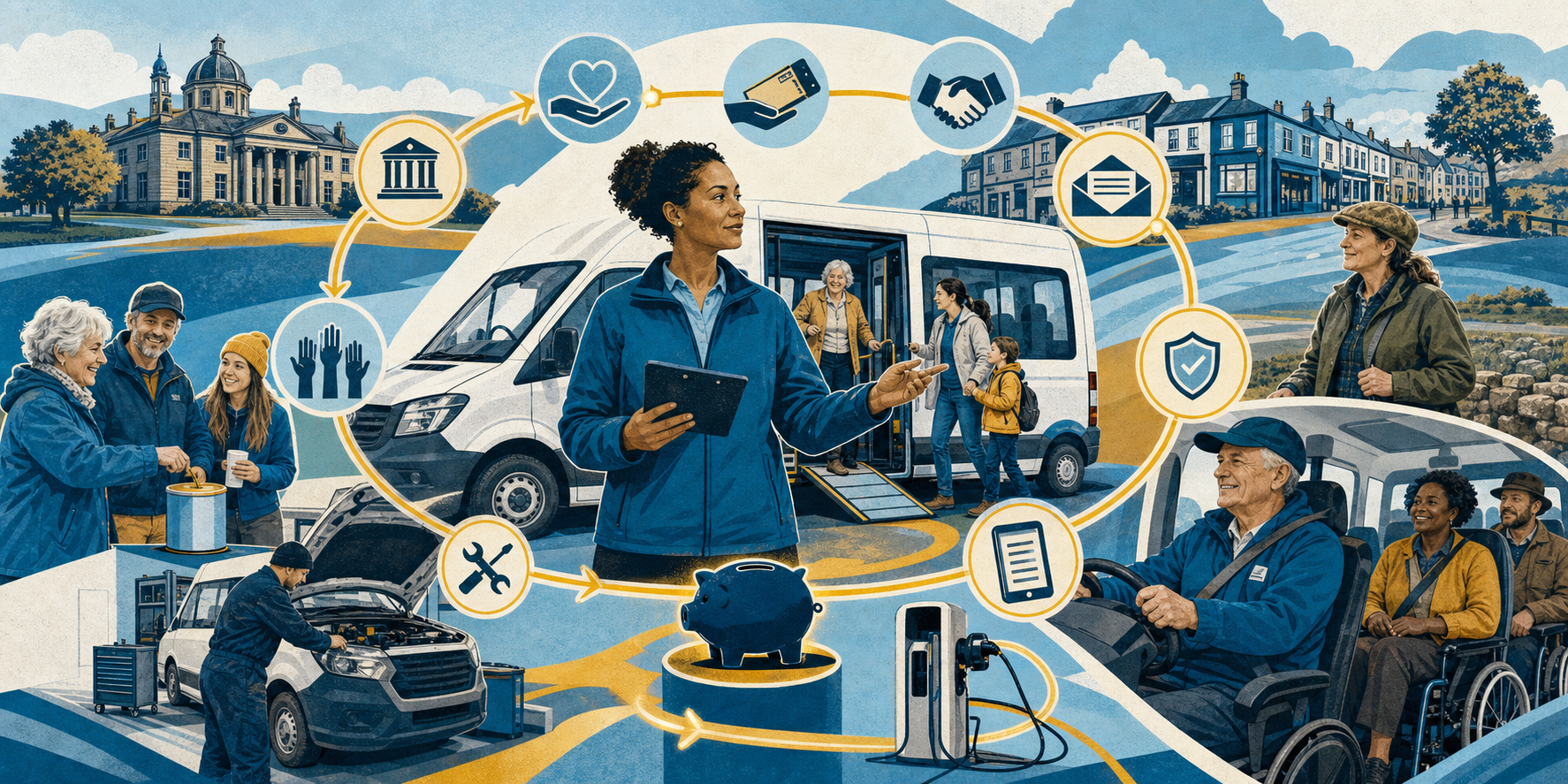
Community transport finance is the mix of grants, fares, membership income, partnerships, fundraising and technology that keeps a scheme running while it serves rural and underserved communities. In the UK almost every operator works within a not for profit framework, so the goal is not to generate profit but to recover costs, build reserves and reinvest any surplus into the service.
These services open up access to work, education, healthcare and social contact for people the wider network leaves behind. Staying financially viable is hard, because funding is limited and demand shifts through the year. This guide sets out the funding and business models UK operators use, and the rules that shape each one.
New to the sector? Start with our overview, Community Transport: Everything You Need to Know, then come back to the finance detail below.
Key takeaways
- Most UK community transport runs on Section 19 or Section 22 permits under the Transport Act 1985, which let not for profit bodies charge for travel without a full PSV operator licence, provided vehicles are never run with a view to profit.
- No single model is enough. Resilient schemes blend grants, fares, membership, partnerships and fundraising so no one funding cut can sink the service.
- Any surplus a permit holder makes must be reinvested in the service, not distributed, which changes how you plan fares, reserves and diversification.
- Volunteer drivers can be reimbursed tax free up to the HMRC approved mileage rate of 55p a mile for the first 10,000 business miles from 6 April 2026, the first rise since 2011.
- Community shares are a real option, but only through an FCA registered community benefit society, and the shares are withdrawable and non transferable rather than ordinary company shares.
- Technology, from a booking platform with a call centre to demand responsive transport, lowers cost per trip and opens the door to contract income.
How is community transport funded in the UK?
Community transport is funded by combining several income streams: grants and subsidies, passenger fares or contributions, membership schemes, partnership and contract work, advertising, fundraising and philanthropy. The exact blend depends on the scheme, its area and the people it serves. What ties them together is the legal basis on which most operators run.
Any organisation that accepts payment for carrying passengers normally needs a PSV operator licence or a private hire licence. Sections 19 and 22 of the Transport Act 1985 create an exemption for bodies that operate without a view to profit, so they can charge for travel under a permit instead. This exemption is the foundation of community transport finance.
A Section 19 permit lets you carry members or the specific groups your organisation exists to help, but not the general public. A Section 22 community bus permit lets you run a registered local bus service open to everyone, and those services can accept concessionary bus pass holders.
The rule that shapes every financial decision is simple. A vehicle used under a permit must not be run with a view to profit, and any surplus must go back into the service. You can still charge fares, sell advertising and win contracts, but the aim is cost recovery and reinvestment, not returns to owners. Plan your fares, reserves and diversification around that.
Government grants and subsidies
Grants and subsidies from local, combined and national authorities remain a core income stream. They typically cover operating costs, vehicle purchase and specific projects that improve service quality. To win them you usually complete an application, then show measurable impact such as reduced isolation or better access to health and essential services.
The Bus Services Act 2025, which received Royal Assent on 27 October 2025, gives local transport authorities greater control over their networks and requires them to identify socially necessary local services and consult on changes. Community operators who build relationships with their authority now are better placed to shape and win that work.
Advantages
- A relatively stable base of income when a grant runs for several years.
- Amounts can be substantial, especially for capital items like accessible vehicles.
Challenges
- Applications are competitive and time consuming.
- Funding can depend on shifting political priorities, which creates risk at renewal.
Best practice
- Build genuine relationships with grant officers and commissioners.
- Report outcomes and impact regularly to justify continued funding. Our reporting tools make this straightforward.
- Diversify income so a single cut does not threaten the service.
Fare based models

Fares are a common income source, charged by distance, time of travel or a flat rate. Because your passengers often rely on the service the most, fares need to stay affordable. Many operators offer concessions for older people, disabled passengers, students or those on low incomes to keep access fair, then recover the shortfall elsewhere.
One point on permits matters here. Concessionary bus pass travel can be accepted on Section 22 community bus services, but not on small vehicles run under a Section 19 permit, where separate fares apply. Check which permit covers each service before you set a fare table, so your income assumptions match what the law allows.
Flat fare systems
A flat fare charges the same amount for every journey regardless of distance. It is simple to run and easy for passengers to understand, which can lift usage. The trade off is that it may under recover on long trips and over charge on short ones, so it suits compact operating areas best.
Distance based fares
Distance based fares charge by the length of the journey, so income tracks the cost of each trip more closely. This reflects real running costs better, particularly across a wide rural area, but it is more complex to administer and communicate, and needs a booking system that can price journeys reliably.
Booking fee plus mileage
A booking fee combined with a mileage charge is one of the more sustainable structures. The fee recovers the admin work behind each trip, while the mileage element covers the driver's travel. It scales naturally with demand and is easy to explain, which makes it a strong fit for community car schemes that depend on volunteer drivers.
When you reimburse volunteer drivers, the HMRC approved mileage rate sets the tax free ceiling. From 6 April 2026 that rate is 55p a mile for the first 10,000 business miles and 25p thereafter, the first change since 2011. Pay at or below it and there is nothing to report. A further 5p a mile applies for each passenger carried.
Subscription and membership models
A membership or subscription model brings a steadier income. Passengers pay a regular fee, monthly or yearly, for unlimited or discounted travel. It rewards regular users, smooths cash flow and builds a sense of ownership. Set the price on real usage data so it supports the service without pushing away the people who need it most.
Advantages
- Income links directly to how much the service is used.
- Fares can be adjusted as demand and running costs change.
Challenges
- Fares alone rarely cover the full cost of an accessible, door to door service.
- You need reliable booking and payment systems to collect fares cleanly.
Best practice
- Research local willingness to pay so fares balance affordability with recovery.
- Offer concessions for the groups who need them, within your permit rules.
- Use technology to simplify collection and cut leakage.
Community based funding

Community based models draw on the people and organisations the service exists for. Fundraising campaigns, sponsored events, donation drives and crowdfunding all raise money and, just as usefully, awareness. Involving residents and local businesses directly builds the relationships that make a scheme resilient when other income tightens.
Volunteer led services
Volunteers are the backbone of much community transport and the single biggest cost saver. They drive, help with admin, and support fundraising and marketing. The saving is real, but so is the effort behind it. You need proper recruitment, training, recognition and retention, plus clear expenses, to keep a volunteer base engaged and safe over time.
Community shares and bonds
Community shares can raise capital from residents and supporters, but they are not ordinary company shares. They are withdrawable, non transferable shares issued only by a co-operative or community benefit society registered with the Financial Conduct Authority under the Co-operative and Community Benefit Societies Act 2014. Each member gets one vote, whatever they invest.
These offers sit outside most financial promotion regulation, so investors are backing a social outcome rather than a financial return. They can lose their money and have no access to the Financial Ombudsman or the compensation scheme. Some schemes instead raise community bonds, which are loans. Both need the right legal structure and honest, clear communication with supporters.
If you are weighing up governance and legal duties before going down this route, our guide to trustee liability and community transport is a useful companion read.
Advantages
- Strong community engagement and a real sense of shared ownership.
- Lower running costs where volunteers deliver much of the service.
Challenges
- Recruiting and keeping volunteers takes ongoing investment.
- Community shares and bonds carry legal and regulatory obligations you must get right.
Best practice
- Run a proper volunteer programme with training, support and recognition.
- Keep finances transparent and accountable to maintain trust.
- Take legal advice before issuing shares or bonds, and be clear with investors about risk.
Partnership models

Partnerships let operators pool resources and share costs with other organisations, businesses and public bodies. Done well, they bring in funding, skills and vehicles you could not fund alone, and they can turn into steady contract income that underpins the rest of the budget.
Public and private partnerships
Working with private companies can add resources and expertise through joint ventures, sponsorship or service contracts. A business might contribute funding, management skill or technology in return for a delivery role or branding. As local transport authorities take on new powers under the Bus Services Act 2025, contracted delivery of socially necessary services is one area worth watching.
Corporate social responsibility
Many companies run corporate responsibility programmes that support local projects. Community operators can approach them for financial help, gifts in kind such as vehicles or technology, or employee volunteering. These relationships often start small and grow, so treat the first project as the beginning of a longer partnership rather than a one off.
Advantages
- Access to funding, vehicles and skills beyond your own resources.
- Fresh expertise and innovation from partner organisations.
Challenges
- Aligning goals and expectations across public and private partners.
- Making sure benefits are shared fairly and the mission stays intact.
Best practice
- Set out roles, responsibilities and expectations clearly in writing.
- Monitor the partnership so both sides keep getting value.
- Play to each partner's strengths to improve the service.
Revenue diversification

Diversifying income reduces reliance on any single stream and builds resilience. The principle is to earn from several sources at once, so a lost grant or a quiet season does not put the whole service at risk. Two routes tend to work well for community operators.
Advertising and sponsorship
Selling advertising space on vehicles, shelters and printed materials brings in extra income, and local firms often value the visible link to a community cause. Section 22 community buses can carry commercial advertising, so check what your permit and any contract allow before you sign a sponsor, then price the space to reflect real reach.
Service diversification
Adding services makes better use of vehicles and drivers you already have. Options include event shuttles, non emergency medical transport and school runs. Each can open a new income stream and lift overall utilisation. Where the work supports a community bus service, income from it can help sustain the local route under a Section 22 permit.
Advantages
- Several income streams cut dependency on one funder.
- Existing vehicles and staff generate more value across the week.
Challenges
- New income needs marketing and sales effort to land.
- Extra work must not crowd out core, socially necessary trips.
Best practice
- Plan advertising and sponsorship properly, with pricing and target markets.
- Base new services on real community needs and gaps in provision.
- Track each new stream so you keep only what pays its way.
Technology driven models

Technology contributes to financial sustainability in two ways: it cuts the cost of every trip, and it makes the service good enough to win contracts. The right community transport software ties booking, scheduling, tracking and reporting together, so a small team can run more journeys with less admin.
Digital platform with a call centre
A booking platform streamlines reservations, adds live tracking and offers convenient payment. Pair it with a call centre so passengers who are less comfortable online can still ring in during opening hours. This blended approach reaches everyone, improves the passenger experience and makes you credible for wider contracts, including public transport work.
Data analytics and forecasting
Analytics turn booking history into decisions. By reading demand patterns you can plan routes, place vehicles and staff where they are needed, and cut empty running. Better use of data lowers cost and gives funders the evidence of impact they want to see before they commit.
Intelligent fleet management
Fleet management systems track vehicles, flag maintenance and monitor fuel. Using GPS and telematics, you can reduce running costs, prevent breakdowns and extend vehicle life. For a scheme where a single accessible minibus is a major asset, keeping that vehicle roadworthy and productive protects both service and budget.
Demand responsive transport
Demand responsive transport schedules trips around real bookings rather than a fixed timetable, so vehicles run where passengers actually are. This flexibility raises efficiency, trims cost and suits scattered rural demand. Route and matching tools do the heavy lifting, grouping compatible journeys through route optimisation.
Advantages
- Higher efficiency and better service quality.
- Cost savings from optimised, better matched operations.
Challenges
- An upfront investment in systems and setup.
- Time to train staff, volunteers and passengers on new tools.
Best practice
- Choose a provider that understands community transport and its rules.
- Involve passengers early so the technology fits how they travel.
- Review usage data and adjust services as demand changes.
Grant funding and philanthropy

Grants and philanthropy sit alongside fares and contracts as a major source of income. Government schemes, charitable trusts and foundations all fund community transport, whether for accessible vehicles, new technology or projects that widen access. Health linked funding is another route, and we cover one important channel in our guide to securing NHS ICB funding.
Winning grants takes planning. Set out your project goals clearly, show the difference it makes to the community, and back it with honest financial projections. Building relationships with funders and partnering with other local organisations both improve your chances, because funders back credible teams as much as good ideas.
Foundations and charitable trusts
Many trusts and foundations, including the National Lottery Community Fund, support transport that improves access and inclusion. Their money can fund running costs, capital projects or new ideas. Match your application closely to each funder's stated aims, because a well targeted bid to the right funder beats a generic bid sent widely.
Crowdfunding
Crowdfunding gathers smaller amounts from a wide base of supporters and raises your profile at the same time. A clear goal, a genuine story and a simple way to give all help. It works best for a specific, tangible aim, such as a new wheelchair accessible vehicle, that people can picture and rally behind.
Advantages
- Access to dedicated funding pots for social and transport aims.
- Scope for significant one off contributions towards big items.
Challenges
- Applications are competitive and take time.
- Funding can depend on donor priorities that shift.
Best practice
- Apply for grants that fit your mission rather than chasing every pot.
- Tell a clear story with concrete goals and outcomes.
- Report on how funds were used to build trust for the next bid.
Building a resilient, blended model

There is no single answer to community transport finance. The strongest schemes blend grants, fares, membership, partnerships, diversification and fundraising, then use technology to keep cost per trip low. Spreading income across sources is what protects the service when any one stream tightens.
Each model carries its own strengths and trade offs, and the right mix depends on your area, your passengers and the permit you hold. Weigh every option against the not for profit rules that govern permits, so surplus is reinvested and the service stays lawful. For a longer view, read our take on the future of community transport.
The goal never changes. Build a service that is resilient and adaptable, that meets the community's evolving needs, and that stays financially sustainable year after year. Get the blend right and the finance follows the mission rather than fighting it.
Frequently asked questions
How is community transport funded in the UK?
Through a blend of income: grants and subsidies from local and national government, passenger fares or contributions, membership schemes, partnerships and contracts, advertising, fundraising and grants from trusts and foundations. Most operators run on a not for profit basis under permits, so the aim is cost recovery and reinvestment rather than profit.
Can a community transport scheme make a profit?
Not if it operates under a Section 19 or Section 22 permit. Those permits require the organisation to run without a view to profit, and any surplus must be reinvested in the service. You can still charge fares, sell advertising and win contracts, but you cannot distribute profit to owners or shareholders.
Do community transport operators need a PSV operator licence?
Not usually. Sections 19 and 22 of the Transport Act 1985 let not for profit bodies charge for passenger transport under a permit instead of a full PSV operator licence. A Section 19 permit serves members and defined groups, while a Section 22 community bus permit covers a registered local service open to the public.
How much can volunteer drivers be paid per mile?
You can reimburse volunteer drivers tax free up to the HMRC approved mileage rate. From 6 April 2026 this is 55p a mile for the first 10,000 business miles in the tax year and 25p after that, plus 5p a mile for each passenger carried. Pay at or below the rate and there is nothing to report.
What grants are available for community transport?
Funding comes from local and combined authorities, national government schemes, health commissioners, and charitable funders such as the National Lottery Community Fund and independent trusts. Grants can cover running costs, accessible vehicles, technology or specific projects. The strongest bids match a funder's stated aims closely and evidence real community impact.
Can a community transport scheme issue community shares?
Yes, but only as a co-operative or community benefit society registered with the FCA. Community shares are withdrawable and non transferable, carry one vote per member regardless of holding, and sit outside most financial promotion rules. Investors back a social outcome, can lose their money, and have no ombudsman or compensation cover.
What is the most sustainable business model for community transport?
A blended one. Relying on a single source, whether grants or fares, leaves a scheme exposed. Combining several income streams, keeping cost per trip low with technology, and reinvesting any surplus gives the best chance of long term sustainability. A booking fee plus mileage structure works particularly well for volunteer based car schemes.
How does the Bus Services Act 2025 affect community transport funding?
The Act, which received Royal Assent on 27 October 2025, gives local transport authorities more control over their networks and requires them to identify socially necessary local services and consult before changing them. For community operators, that creates openings to shape and deliver contracted services, so building a strong relationship with your authority matters more than ever.