



The cost of getting around Britain has climbed on almost every front. Fuel, fares and public funding have all moved in the wrong direction for passengers and providers alike, and the strain is landing hardest on the rural and community services that many people rely on to reach work, healthcare and each other.
This article sets out where the increasing cost of transport stands in 2026, why they have risen, and what community transport operators can do to stay sustainable.
Key Takeaways
- Average petrol reached around 159p a litre and diesel around 185p by late May 2026, after steep spring rises linked to disruption in the Strait of Hormuz.
- Bus fares outside London rose by roughly 15 per cent in the year to autumn 2025, well ahead of inflation, even with the £3 single fare cap in place until March 2027.
- Government support for local buses in England was about £3 billion in the year to March 2025, yet bus mileage still sits below pre-pandemic levels.
- The HMRC approved mileage rate rose from 45p to 55p a mile from 6 April 2026, its first increase since 2011, which matters directly for volunteer drivers.
- Demand for community and assisted transport keeps climbing as the population ages, so efficient scheduling and smarter use of vehicles are now essential.

Why is the cost of transport rising in the UK?
Three pressures are pushing transport costs up at the same time: volatile fuel prices, rising fares, and long term cuts to the public funding that keeps non commercial routes running. Each one feeds the others, and together they leave passengers paying more for a network that in many places offers less.
Fuel prices have surged again
Fuel is the clearest example of how quickly costs can move. After a relatively calm start to the year, prices climbed sharply through the spring of 2026 as conflict in the Middle East disrupted oil and gas flows through the Strait of Hormuz. By late May 2026, average petrol prices had reached roughly 159p a litre and diesel around 185p, according to Government weekly road fuel price data, with diesel peaking near 192p a litre in mid April before easing slightly.
To put that in context, the RAC described the spring rises as some of the fastest ever recorded in a single month, though prices remained below the all time highs of summer 2022, when petrol reached around 191p and diesel almost 199p. The Government has kept the temporary 5p fuel duty cut in place and frozen duty through 2026, which offers some relief, but for services that run diesel minibuses every day even small movements at the pump add up quickly across a year.
Bus fares are climbing faster than inflation
Passengers have felt the squeeze on fares too. The national £3 single fare cap in England outside London has held down the very highest fares, yet the overall picture is still one of rising prices. Department for Transport figures show the local bus fares index outside London rose by around 15 per cent in the year to September 2025, far ahead of the 3.8 per cent rise in the Consumer Price Index over the same period. Much of that jump reflects the cap itself moving up from £2 to £3 at the start of 2025.
The fare cap has a clear end point. Introduced at £2 in January 2023 and raised to £3 in January 2025, it has been extended until March 2027, backed by around £150 million of funding. What happens after that remains uncertain, and any change to the scheme would feed straight through to what passengers pay. London and Greater Manchester continue to run their own lower fare limits.
Council funding cuts have thinned the network
Behind the fares sits a longer term problem. Supported bus services, the socially necessary routes that councils pay for because they are not commercially viable, have been squeezed for well over a decade. Total net Government support for local buses in England stood at around £3 billion in the year to March 2025, of which roughly £0.8 billion covered concessionary travel, according to official annual bus statistics. Despite this, bus mileage across England remained at only about 89 per cent of pre-pandemic levels, and lower still outside London.
Rural areas have borne the brunt, where a single withdrawn route can leave whole villages without a viable link to town. There is, at least, a shift in policy direction. The Bus Services Act 2025 gives local authorities stronger powers to franchise services, lifts the ban on councils setting up their own bus companies, and introduces protections that make it harder to cancel socially necessary routes at short notice. Whether that reverses years of decline will depend on sustained, long term funding rather than one off grants.
What does this mean for community and assisted transport?
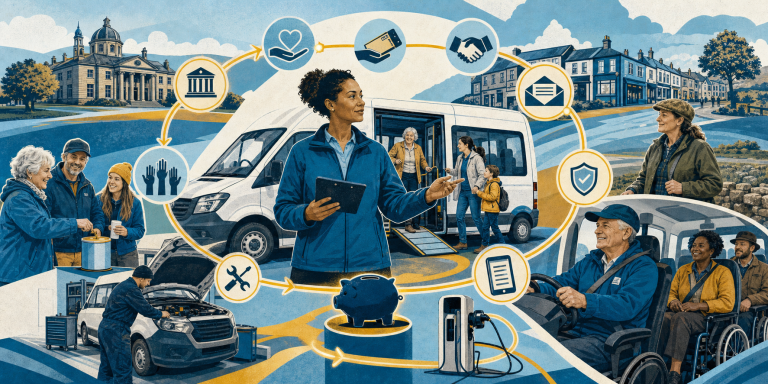
As mainstream services shrink and fares rise, more people turn to community transport to reach medical appointments, shops, day centres and family. That demand is not a short term spike. It reflects a deep demographic shift that will shape the sector for decades.
Around 11 million people in England, close to one in five, are already aged 65 and over, according to the Centre for Ageing Better. Office for National Statistics projections suggest the UK population aged 65 and over will grow by roughly a third, from about 13.4 million in 2025 to 18 million by 2050, with the number of people aged 75 and over rising by more than half. Many of these residents will not drive, and many live exactly where scheduled buses are being cut back. The result is a widening gap that community and assisted transport is increasingly asked to fill.
Rising costs reach volunteer drivers too
Higher fuel prices do not just affect minibuses. They affect the volunteer car schemes that underpin so much community transport, where drivers use their own vehicles and are reimbursed per mile. Here there is some welcome news. From 6 April 2026 the HMRC approved mileage rate rose from 45p to 55p a mile for the first 10,000 business miles, its first increase since 2011, according to the House of Commons Library. The 25p rate above 10,000 miles and the 5p per passenger payment are unchanged.
The higher ceiling lets schemes reimburse volunteers more generously without creating a tax liability, which helps retain drivers at a time when running a car has become far more expensive. It does not remove the underlying pressure, but it is a meaningful lever for coordinators worried about losing volunteers to rising motoring costs.
How can transport services respond to rising costs?
Operators cannot control fuel markets or Treasury decisions, but they can control how efficiently every mile, vehicle and volunteer hour is used. When budgets are tight, the services that thrive are the ones that squeeze more value from the resources they already have.
- Cut empty running. Smarter scheduling and shared journeys reduce the dead miles that quietly drain fuel budgets. Demand responsive transport matches vehicles to real demand rather than fixed timetables, which can lift occupancy and lower cost per passenger.
- Reduce administrative overhead. Time spent on paper diaries, spreadsheets and manual reconciliation is time not spent moving people. Moving from paper to the cloud removes duplicated effort and frees coordinators for frontline work.
- Protect volunteers. Clear mileage records, prompt reimbursement at the new 55p rate and simple booking tools all help retain the drivers a service depends on.
- Plan for demand, not just today. Building capacity to grow, merge or absorb withdrawn routes is easier with systems that scale without heavy upfront cost.
Cutting corners on the wrong things can backfire. As we have written before, trimming investment in the systems that keep a service efficient often costs more in the long run through lost productivity and missed journeys. For a broader look at where savings can safely be made, our guide to cutting costs and boosting productivity sets out practical steps, and our overview of community transport funding covers the grants worth pursuing.
Frequently asked questions
Why is the cost of transport rising in the UK?
Costs are rising because of three overlapping pressures: volatile fuel prices driven by global events, fares climbing faster than inflation, and years of cuts to the public funding that supports non commercial routes. Together these push up the price of travel while reducing the choices available, especially in rural areas.
How much have bus fares gone up?
Department for Transport figures show the local bus fares index outside London rose by around 15 per cent in the year to September 2025, compared with a Consumer Price Index rise of 3.8 per cent. A large part of that reflects the national single fare cap increasing from £2 to £3 at the start of 2025.
Is the £3 bus fare cap still in place?
Yes. The £3 single fare cap for local bus services in England outside London has been extended until March 2027. London and Greater Manchester operate their own separate fare limits.
What is the HMRC mileage rate for 2026?
From 6 April 2026 the approved mileage allowance for cars and vans is 55p a mile for the first 10,000 business miles, up from 45p, then 25p a mile after that. This is the first change since 2011 and is particularly relevant to volunteer car schemes that reimburse drivers per mile.
Why does this matter for community transport?
As scheduled services are cut and fares rise, more people, particularly older residents, depend on community and assisted transport to stay mobile. With an ageing population, demand will keep growing, so services need to run as efficiently as possible to meet it within tight budgets.
Meeting rising transport costs with Road XS
The increasing cost of transport is not going away, but it can be managed. Road XS was built on modern cloud technology to help community transport services do more with less, letting you expand, merge and grow without the heavy upfront costs usually tied to large technology projects. With no upfront fee and every feature included, it fits your existing budget so you can stay sustainable whatever pressures come your way.
From smarter scheduling and demand responsive transport to effortless mileage and booking management, Road XS keeps your focus where it belongs: on the passenger. If rising costs are stretching your service, we would love to show you how much easier it can be.