




Demand responsive transport, usually shortened to DRT, is a bus that goes where passengers ask it to. There is no fixed timetable. People book a journey by app or phone, and software groups them into shared trips. It now runs across rural and suburban Britain as councils look for new ways to keep villages connected.
This guide explains what demand responsive transport is, how it works and where it succeeds or struggles, using real UK schemes and Department for Transport evidence. It is written for councils, operators and community transport teams planning a service, and for the drivers, passengers and carers who use one every day.
Key Takeaways
- Demand responsive transport is shared public transport that runs to passenger bookings rather than a fixed timetable, usually in smaller vehicles (DfT guidance).
- It works best in low density areas and at quiet times, but DfT warns it is no silver bullet and usually needs ongoing local authority support.
- The DfT's Rural Mobility Fund pilots carried 823,490 passenger journeys, and 87% of bookings were made in an app (DfT evaluation).
- Results vary. Worcestershire on Demand keeps expanding, while Tees Flex closed in March 2026 after councils judged it poor value.
- Success depends on clear aims, the right zone size, phone and app booking and good data, as the Travel Derbyshire on Demand pilot showed.
What is demand responsive transport?
The Department for Transport defines demand responsive transport as "a flexible service that provides shared transport at separate fares in response to requests from users", who say where and when they want to travel (DfT, 2025). In plain terms, the passenger tells the service where and when, and the route follows.
DRT sits between a normal bus and a taxi. Like a bus, it is shared, open to the public and charges individual fares. Like a taxi, it picks up close to where people are and only runs when someone has asked for a journey. Most services use minibuses or large cars rather than full size buses.
You will also hear it called on demand transport, a flexible bus or bus on demand. Well known UK names include fflecsi in Wales and Worcestershire on Demand in England. Our guide to city transport explains how DRT fits alongside fixed routes in larger towns and cities.
How does demand responsive transport work?
Demand responsive transport works by turning individual requests into shared journeys. Each passenger books a trip, the scheduling software checks which vehicle can take it without breaking promises to anyone already booked, and the route is rebuilt. A good system does this in seconds, so passengers get a pickup time straight away.
A typical journey runs like this:
- The passenger books through an app, a website or a phone call to the booking office, giving a pickup point, destination and time.
- The software matches the request to a vehicle, grouping people heading the same way so seats are shared.
- The route updates and the driver's app shows the new stop, often with a precise location such as a what3words address.
- The passenger is picked up at their door, a nearby corner or a virtual stop, and dropped off within the zone.
- The data is recorded, including who travelled, when and where, which funders and councils later rely on.
Services come in two main forms. Zone based DRT carries people anywhere within a set area, sometimes with links to a rail station or town centre. Semi flexible services follow a core route but leave it to collect booked passengers. Our article on route optimisation explains how the grouping and routing work behind the scenes.
How is DRT different from a bus, Dial-a-Ride or taxi?
People often confuse DRT with Dial-a-Ride or a shared taxi. The differences matter, because they change who can travel, how it is licensed and how much it costs to run. The table below compares the four most common options for local journeys where a fixed bus is thin on the ground.
| Fixed route bus | Demand responsive transport | Dial-a-Ride | Taxi | |
|---|---|---|---|---|
| Route | Set route and timetable | Built from bookings in a zone | Built from bookings | Door to door, one party |
| Who can travel | Anyone | Anyone, if registered as a local bus service | Usually eligible members only | Anyone who hires it |
| Booking | None | App, web or phone | Mostly phone, booked ahead | Phone, app or rank |
| Fares | Individual fares, bus passes accepted | Individual fares, bus passes often accepted | Set fare or membership | Whole vehicle fare |
| Typical vehicle | Full size bus | Minibus or large car | Accessible minibus | Car |
Dial-a-Ride is usually run by community transport groups for older and disabled people, while DRT is normally open to everyone. Many operators run both, often on the same software. Our community transport guide and Dial-a-Ride software page cover that side in more detail.
Where does demand responsive transport work best?
DfT guidance says DRT "can complement fixed route public transport services and improve mobility in low density areas and at low demand times of day" (DfT, 2025). That usually means rural villages, market towns, edge of town estates, business parks and evening or Sunday gaps when a full bus would run nearly empty.
The same guidance is blunt about limits. It says DRT "should not be regarded as a silver bullet" and is unlikely to be commercially profitable, so it will usually need sustained council or other support. Where demand is steady along one corridor, a well timed fixed bus often carries more people for less money.
The honest test is simple. If passengers mostly travel between the same few points at the same times, a timetable probably serves them better. If trips are scattered across a wide area and spread through the day, DRT can reach people a fixed route never would. Many areas need a blend of both.
What are some UK examples of demand responsive transport?
There are dozens of DRT services across the UK, run by councils, bus companies and community transport groups. Some have grown steadily for years, while others have closed when funding ended or costs rose. These four examples show the range of what has worked and what has not.
Worcestershire on Demand
Worcestershire County Council began in Bromsgrove in July 2021 and has kept expanding. By July 2025 its Bromsgrove zone had completed over 104,000 trips, and new zones were planned for Wychavon, central Worcestershire and Wyre Forest (Worcestershire County Council). Journeys are booked in an app and capped at 15 kilometres.
fflecsi in Wales
Transport for Wales runs fflecsi, which lets people book by phone or app, "a bit like a taxi service". It now operates in twelve areas, including the Conwy Valley, the Llŷn Peninsula, Pembrokeshire, Blaenau Gwent and Machynlleth (Transport for Wales), showing how one brand can serve very different rural communities.
Travel Derbyshire on Demand
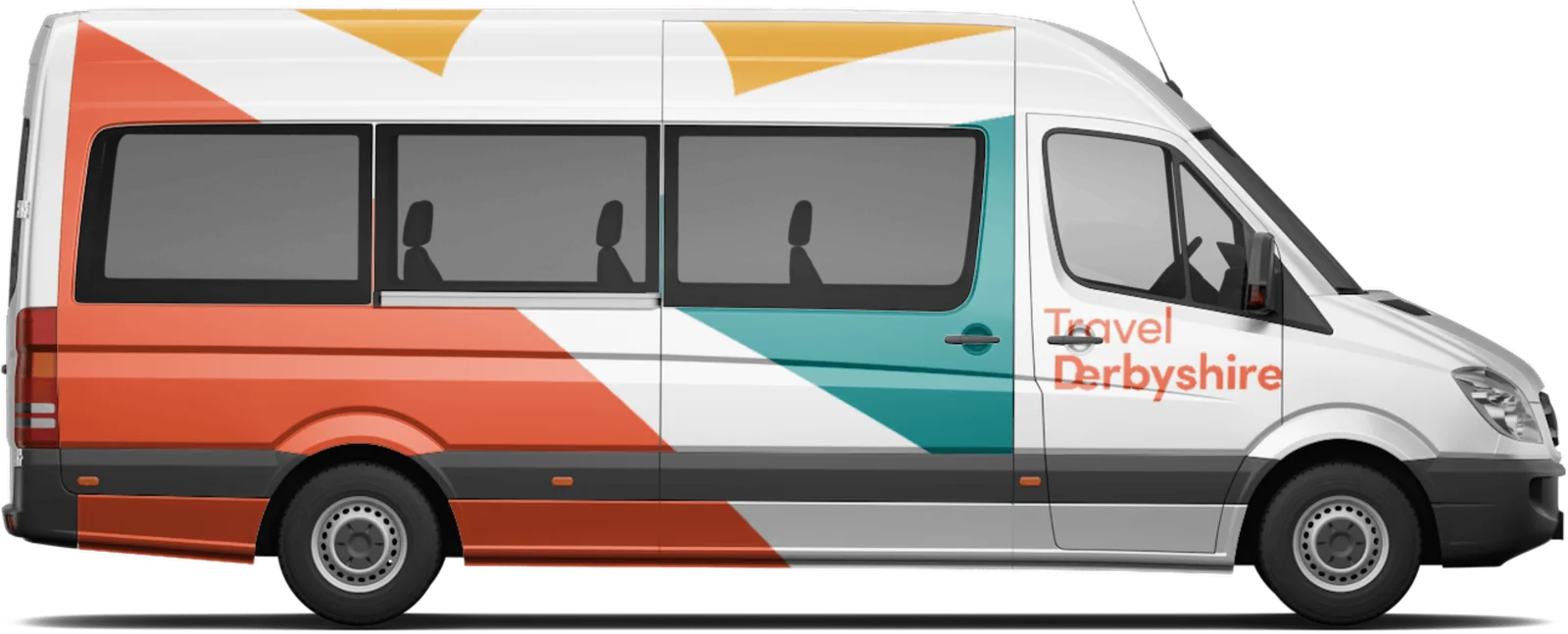
The Travel Derbyshire on Demand pilot ran from 21 February 2024 to 29 August 2026 across about 230 square miles of Chesterfield, Bolsover and North East Derbyshire. Two vehicles carried 14,148 passenger journeys over 764 operating days, and 12.3% of journeys carried a wheelchair user. Road XS provided the platform throughout.
Tees Flex
Tees Flex started in early 2020 and closed on 31 March 2026. Darlington's council leader said it met only about 63% of booking requests, cost just under £19.50 per journey in subsidy, and carried more than one person only 36% of the time. The money now funds two fixed hourly routes instead (North East Bylines).
The closure is a useful lesson rather than a verdict on DRT. A zone that is too large for its fleet, with little grouping of passengers, behaves like a subsidised taxi. The schemes that last usually match fleet size to demand and keep a close eye on shared trips.
What did the Rural Mobility Fund pilots show?
The Rural Mobility Fund was the DfT's largest trial of DRT in England. It gave £19.4 million to 15 local authorities, and 18 schemes were running by the end of the evaluation. Together they carried 823,490 passenger journeys up to September 2024 (DfT Rural Mobility Fund evaluation).
The evaluation found some clear patterns:
- Apps dominate. 87% of journeys were booked in an app, and 11% by phone to a call centre.
- Concessionary use matched rural buses. Around 26% of journeys were made on a concessionary pass.
- Stations and town centres were the most popular destinations, with peaks between 8am and 10am and 3pm and 5pm.
- Fares covered little of the cost. Revenue averaged £2.01 per passenger journey, so schemes needed ongoing subsidy.
Those findings line up with Derbyshire. The share of Travel Derbyshire bookings made in the app rose from 54.6% in 2024 to 64.4% by August 2026, and 28.1% of journeys used a concessionary pass. Phone booking still mattered for a large minority, which is why no DRT service should be app only.
How is demand responsive transport funded and regulated?
Most DRT in England is paid for by local councils, topped up by fares and sometimes by developers or employers through planning agreements. In December 2025 the government announced £3 billion of multi year bus funding to 2028 to 2029, around £700 million a year, mainly through the new Local Authority Bus Grant (DfT).
Revenue funding, which pays for day to day services such as DRT, is £481 million a year, and each council's share is in the LABG revenue allocations for 2026 to 2029. That certainty matters, because the Rural Mobility Fund evaluation found fares covered only a small share of DRT running costs.
The Bus Services Act 2025, which became law in October 2025, gives councils more say over local networks. It lets them identify socially necessary services that operators cannot simply cancel, and makes franchising easier. Our guide to the Bus Services Act 2025 covers the detail.
On licensing, DRT open to the public is registered as a local bus service. DfT guidance sets out three routes:
- A PSV operator licence, the standard licence held by most bus companies.
- A Section 22 community bus permit under the Transport Act 1985, used by community transport groups.
- A restricted PSV operator licence under Section 12, which lets taxi and private hire operators run DRT.
What makes a DRT service succeed?
DfT guidance warns that "simply establishing a scheme and expecting it to run itself is unlikely to lead to a successful deployment" (DfT, 2025). The schemes that last share a handful of habits, and most of them are about planning and data rather than vehicles.
- Clear aims. Decide whether the service is about access to work, health, stations or reducing isolation, and measure that.
- A zone that fits the fleet. Derbyshire found fleet size, not area, was the real limit on what a service could offer.
- Two ways to book. Keep a phone line for people without smartphones, as Derbyshire did throughout its pilot.
- Shared trips. Track how often vehicles carry more than one passenger, because that decides the cost per journey.
- Good data from day one. Record unmet requests, trip purpose and accessibility needs, not just completed journeys.
- Time to grow. Allow time for travel habits to form, and budget for marketing to build regular riders.
The Tees Flex figures show what happens when these slip. Meeting only part of booking requests, carrying single passengers most of the time and running empty between jobs all push the cost per journey up. The same data, watched early, gives councils the chance to resize a zone before funding runs out.
What DRT means for each role
DRT touches many people, from the councillor approving the budget to the passenger waiting at the kerb. Here is what matters most to each group.
Councils and central government
Start with the gap you want to close, not the technology. Set targets for passengers, shared trips and cost per journey, and review them every quarter. Multi year funding from the Local Authority Bus Grant makes it easier to give a scheme the time it needs to settle and grow.
Operators and community transport teams
Community transport groups can run DRT under a Section 22 permit, often alongside Dial-a-Ride and car schemes. That can open new contract income, but it needs reliable scheduling and reporting. Our guide to community transport grant funding covers other routes to money.
NHS transport teams and public sector buyers
Many DRT trips end at a surgery, clinic or hospital. Talking to your local DRT scheme can give patients who are not eligible for NHS patient transport a reliable way to reach appointments. Ask for journey data by destination, so you can see how many health trips it already carries.
SEND, school and DRT operational leads
Councils can use the same vehicles for school runs at peak times and DRT in between, which spreads fixed costs. That only works if scheduling handles both, with passenger notes, trained assistants and clear safeguarding. Test any system on your busiest morning before you commit.
Drivers
DRT driving is different from a fixed route. Your list of stops changes during the shift, so a clear driver app with live updates and precise pickup points matters. Report any recurring problems with stops or timings, because that feedback helps planners improve the zone.
Passengers, carers and families
Download the app or save the booking number before you need it, and book as early as you can for regular trips. Tell the operator about wheelchairs, walking aids or a carer travelling with you. Most services accept older and disabled person's bus passes where they are registered as local buses.
Where Road XS fits
Road XS provides DRT software for councils, operators and community transport teams. Passengers book by app or phone, routes rebuild as bookings change, drivers navigate to within three metres and every journey is recorded for reporting. It ran the Travel Derbyshire on Demand pilot from launch to close.
If you are planning a new service or reviewing an existing one, the lessons above apply whichever system you choose. When you are ready to compare platforms, see how Road XS handles demand responsive transport software or talk to our team about your area.
Frequently asked questions
What is demand responsive transport?
Demand responsive transport, or DRT, is shared public transport that runs to passenger bookings rather than a fixed timetable. People book by app or phone, and software groups journeys so vehicles carry several passengers. It usually uses minibuses or large cars and works best in rural areas and at quiet times.
How does demand responsive transport work?
A passenger books a journey with a pickup point, destination and time. The scheduling software finds a vehicle that can fit the trip around existing bookings, updates the route and sends it to the driver's app. The passenger is then collected at their door or a nearby virtual stop.
Is demand responsive transport the same as Dial-a-Ride?
No. Dial-a-Ride is usually run by community transport groups for older and disabled members who register in advance. DRT registered as a local bus service is open to anyone. Both use bookings rather than timetables, and many operators run the two side by side on the same system.
Can I use my bus pass on demand responsive transport?
Often, yes. Where a DRT service is registered as a local bus service, older and disabled person's bus passes are usually accepted, though the rules can vary by area and time of day. Check with the operator or your council before you travel.
Do I need a smartphone to use DRT?
Usually not. Most UK services take bookings by phone as well as by app. In the Rural Mobility Fund pilots, 11% of bookings came by phone, and in Derbyshire more than a third of 2026 bookings were made outside the app. A good service should never be app only.
Is demand responsive transport cheaper than a bus?
It depends on demand. In scattered, low demand areas DRT can reach more people for the same money as a near empty bus. Where many people travel the same route, a fixed bus is usually cheaper per passenger. Most DRT schemes need ongoing council funding.
Who pays for demand responsive transport in the UK?
Most schemes are funded by councils, with fares covering part of the cost. Money has come from the Rural Mobility Fund, bus service improvement funding and now the Local Authority Bus Grant. Some schemes also receive developer or employer contributions through planning agreements.
Planning a demand responsive service or reviewing one you already run? Book a Road XS demo or talk to our team about your area.

