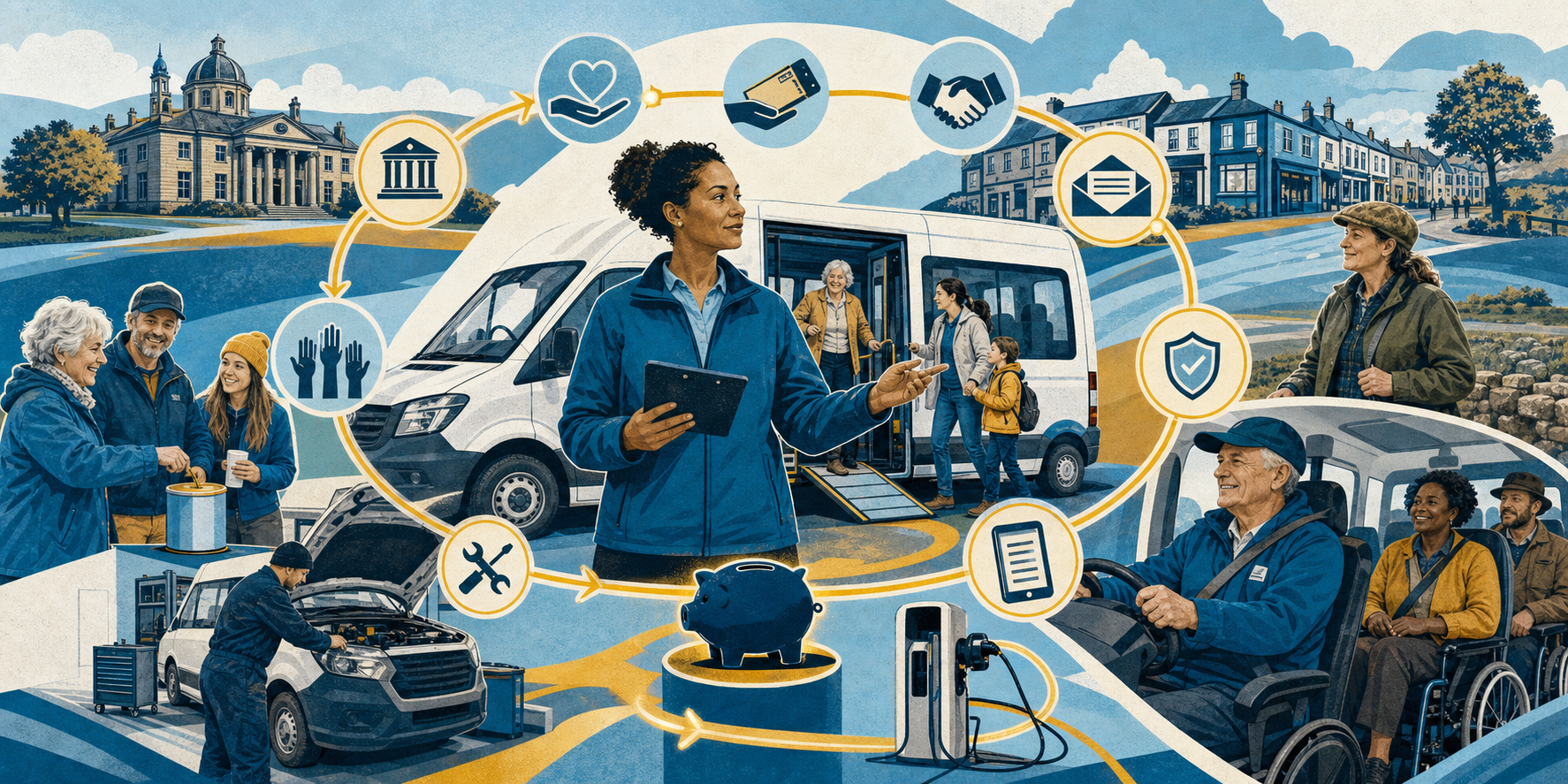
Losing the ability to drive should not mean losing your independence. Across the UK, a wide network of schemes helps older and disabled people keep moving. This guide explains the link between elderly and transportation.
It covers free bus passes, railcards, Blue Badges, community transport and NHS journeys, with simple steps to access each one.
Key Takeaways
- Free bus travel is available to older people at State Pension age in England, and from age 60 in London, Scotland, Wales and Northern Ireland.
- A disabled person's bus pass and the Blue Badge scheme support travel based on eligibility rather than age.
- Community transport, including Dial a Ride and voluntary car schemes, fills the gap where public transport cannot reach.
- The NHS funds patient transport only where there is a genuine medical or mobility need, so many people rely on community or council schemes instead.
- Cloud based booking software helps councils, charities and the NHS run these services safely and at scale.
What transport is available for elderly and disabled people?
Transport for elderly and disabled people in the UK is not a single service. It is a mix of national schemes, council run services and charity led projects. Knowing what exists, and who qualifies, makes planning far easier for passengers, carers and the teams who arrange journeys.
- Concessionary bus passes for older and disabled travellers
- Discounted rail travel through railcards
- The Blue Badge parking scheme
- Community transport, including Dial a Ride and voluntary car schemes
- Demand responsive transport that you book when you need it
- NHS non-emergency patient transport for eligible medical journeys
When it comes to elderly and transportation, the sections below explain each option in turn, starting with the free schemes most people ask about.
Is there free transport for elderly and disabled people in the UK?
Yes. Options for free transport for elderly and disabled UK residents start with two schemes. The older person's bus pass gives free local bus travel based on age. The disabled person's bus pass gives free travel based on eligibility, at any age. Both are issued by your local council.
Transport for elderly and disabled UK schemes are devolved, so the rules differ across the four nations. The list below shows how the free bus pass works in each part of the UK.
- England: free bus travel starts at State Pension age, currently 66 and rising to 67 between 2026 and 2028 (GOV.UK). Free travel runs from 9:30am to 11pm on weekdays and all day at weekends and on bank holidays. Some councils extend these hours.
- London: a 60+ Oyster photocard gives free travel from age 60 for people who live in a London borough (Transport for London).
- Scotland and Wales: free bus travel is available from age 60.
- Northern Ireland: a 60+ SmartPass is available from age 60, and a Senior SmartPass from age 65 (nidirect).
- Disabled person's bus pass: available at any age based on eligibility set by your council (GOV.UK). In many areas, a companion pass lets a carer travel free.
How do railcards cut the cost of rail travel?
Trains are rarely free, but railcards make them much cheaper. Two cards matter most for older and disabled passengers. Each one pays for itself in only a couple of journeys, then keeps saving money on almost every trip after that.
- Disabled Persons Railcard: £20 for one year or £54 for three years. It gives a third off most fares for the holder and one adult companion, at any time of day (Disabled Persons Railcard).
- Senior Railcard: for anyone aged 60 or over, £35 for one year. It gives a third off, mainly on off peak journeys (Senior Railcard).
Both railcards work alongside free Passenger Assist, which arranges help with boarding, luggage and changing trains when you book ahead (National Rail).
What is the Blue Badge scheme and who qualifies?
The Blue Badge scheme helps people with mobility needs park closer to where they need to be. It runs across England, with similar schemes in Scotland, Wales and Northern Ireland. Around 2.5 million Blue Badges are on issue in England, which shows how widely the scheme is used (Department for Transport).
In England, you qualify automatically for a Blue Badge if you are aged 3 or over and one of the following applies (House of Commons Library):
- You receive the higher rate mobility component of Disability Living Allowance
- You score 8 points or more on the moving around part of Personal Independence Payment
- You are registered blind or severely sight impaired
- You receive certain other qualifying benefits
Other people may still qualify after an assessment by their council. You can apply for a Blue Badge or renew one on GOV.UK, and Age UK explains the process.
How does community transport help older and disabled passengers?
Where buses and trains cannot reach, community transport steps in. These are local, often charity run services that offer door to door journeys. They are a lifeline for people in rural areas, those without a car, and anyone who finds mainstream public transport hard to use.
- Dial a Ride: pre booked, accessible minibuses for shopping, appointments and social trips. Membership is usually required and fares are close to normal bus fares.
- Voluntary car schemes: volunteer drivers use their own cars for pre booked journeys, often for a mileage or membership fee.
- Demand responsive transport: flexible services you book when you need them, rather than following a fixed timetable.
Scheme coordinators, transport managers and volunteers keep these services running day to day. Trustees, charity leaders and council decision makers hold the funding and the duty of care. The Community Transport Association offers guidance on permits, driver training and safe operation.
Can older and disabled people get NHS transport to appointments?
Some can, but not everyone. NHS non-emergency patient transport is for people with a genuine medical or mobility need. Under national rules from NHS England, most patients are expected to travel independently, with help from family or friends where possible (NHS England).
A patient is likely to qualify if one or more of these applies:
- A medical need that makes other transport unsafe
- A cognitive or sensory impairment that needs support during the journey
- A significant mobility need that rules out private transport, public transport or a taxi
- A safeguarding need
Patients who do not qualify are usually pointed towards community transport or volunteer schemes. People on a low income may also claim travel costs back through the NHS Healthcare Travel Costs Scheme (NHS).
How can technology improve transport for elderly and disabled people?
Behind every reliable journey sits a lot of coordination. Bookings, accessible vehicles, volunteer drivers and changing needs all have to line up. Cloud based booking software helps councils, charities and NHS teams manage this at scale, without losing the personal touch that passengers value.
- Simple booking by phone, online or through a coordinator, so no one is left out
- Smart scheduling that matches passengers to the right accessible vehicle and driver
- Safer transfers, with clear records for sensitive journeys
- Fewer missed appointments and better use of volunteer time
- Updates that reassure carers and family members
At Road XS, the aim is never to replace people. It is to give operators, drivers and volunteers the tools to do more, more easily. Good software supports the human side of transport rather than removing it, which matters most when the passenger is elderly, disabled or vulnerable.
Frequently asked questions
Who qualifies for free transport for elderly and disabled UK residents?
Older people qualify for a free bus pass at State Pension age in England, or from age 60 in London, Scotland, Wales and Northern Ireland. Disabled people can qualify for a free disabled person's bus pass at any age, based on eligibility set by their local council.
At what age do you get a free bus pass in England?
In England, free bus travel starts at State Pension age. This is currently 66 and is rising to 67 between 2026 and 2028. London residents can apply for a 60+ Oyster photocard from age 60.
Is transport for elderly and disabled people the same across the UK?
No. Many schemes are devolved, so entitlements differ by nation. Bus pass ages, SmartPass rules in Northern Ireland and local community transport all vary. Always check with the relevant local council or transport authority.
How do I arrange elderly and disabled transportation to a hospital appointment?
First check if you qualify for NHS non-emergency patient transport, which is based on medical and mobility need. If you do not qualify, contact a local community transport scheme or voluntary car scheme. People on a low income may reclaim costs through the Healthcare Travel Costs Scheme.
What is the difference between Dial a Ride and a voluntary car scheme?
Dial a Ride uses accessible minibuses for pre booked journeys, often with membership and set fares. A voluntary car scheme uses volunteer drivers in their own cars, usually for a mileage or membership fee. Both offer door to door travel.
How much does a Disabled Persons Railcard cost?
A Disabled Persons Railcard costs £20 for one year or £54 for three years. It gives a third off most rail fares for the holder and one adult companion, at any time of day.
Can carers or family members travel with an older or disabled passenger?
Often, yes. Many disabled people's bus passes include a companion pass. The Disabled Persons Railcard discount also covers one adult companion. Community transport and NHS patient transport may allow an escort where there is a clear need.