



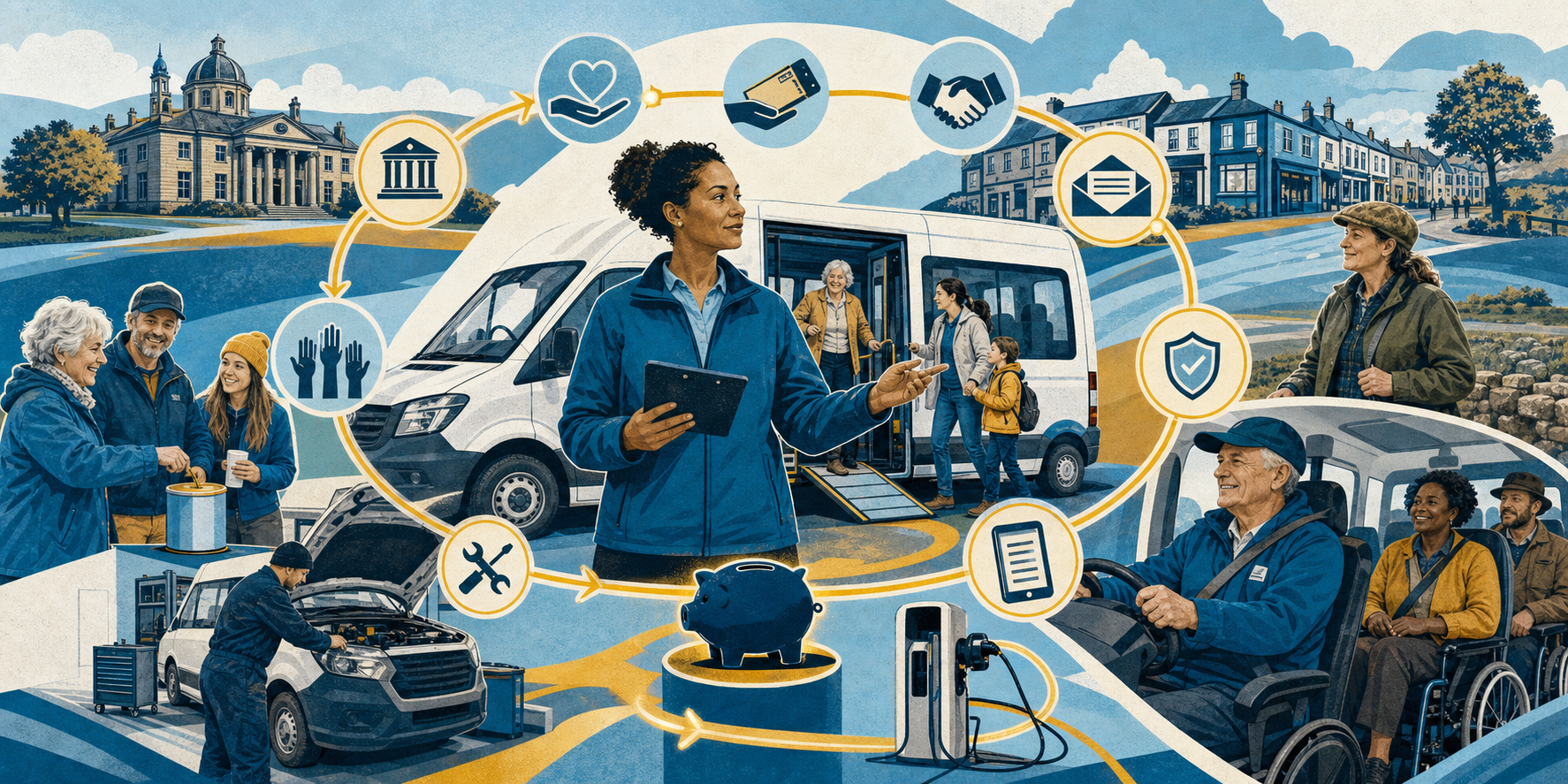
Sustainable community transport models are service designs built to last. They balance three things at once: money, emissions, and people. Funding has to come from more than one place. Vehicles have to get cleaner over time. Drivers and volunteers have to keep turning up. Weaken any one of those and the service eventually stops.
That matters more than ever in 2026. Domestic transport is now the single largest source of UK emissions. Bus mileage in county areas has fallen sharply. Grant cycles remain short. Meanwhile demand for door to door travel keeps climbing as the population ages and health services move into neighbourhoods.
This article sets out the models that actually hold up in the UK. It covers service design, funding mix, fleet decarbonisation, volunteer supply, policy, and measurement. It is written for coordinators, transport managers, trustees, local councils, NHS teams, and central government alike.
Key Takeaways
- Sustainability has three legs. Financial, environmental, and social. A scheme that decarbonises but loses its volunteers is not sustainable, and neither is one that balances the books on a fleet it cannot replace.
- Domestic transport is the UK's biggest emitter, accounting for 31% of net greenhouse gas emissions in 2025, and emissions from the sector rose again that year.
- Only 3% of community transport vehicles in England are electric. Cost, charging access, and vehicle availability remain the main blockers, so most operators need a phased fleet plan rather than a single switchover.
- Blended income beats grant dependence. Around 77% of operators rely on grant income, which is time limited and costly to chase. Contracts, fares, membership, and partnerships spread the risk.
- Good data is now the price of entry. The Bus Services Act 2025 and tighter local budgets both reward schemes that can prove reach, cost per journey, and social value.
What are sustainable community transport models?
A sustainable community transport model is a way of running accessible local travel that can survive beyond its current funding round. It covers how the service is designed, how it is paid for, what it drives, and who drives it. The test is simple. Could this still be running in ten years?
Most people hear "sustainable" and think emissions only. In this sector the word has to work harder. A scheme can run a spotless electric fleet and still fold when a three year grant ends. Another can be financially secure but stuck with ageing diesel minibuses it cannot afford to replace.
So a workable model has to hold three things together.
- Financial sustainability. Income comes from several sources. No single cut can end the service.
- Environmental sustainability. The fleet gets cleaner over time, and empty running is designed out.
- Social sustainability. Drivers, volunteers, and staff are recruited and kept, and passengers trust the service.
Most UK schemes operate under Section 19 or Section 22 permits of the Transport Act 1985. These allow not for profit bodies to charge for travel without a full PSV operator licence. Any surplus is reinvested, not distributed. That shapes every model that follows.
Why does sustainable public transit in the UK depend on community transport?
Because the mainstream network no longer reaches everyone. Any honest discussion of sustainable public transit in the UK has to start with the gap. Fixed route buses have retreated from rural and edge of town areas for over a decade, and something has to fill that space.
The scale of that retreat is well documented. The House of Commons Transport Committee's Buses connecting communities report, published in August 2025, cites DfT figures showing bus journeys in England fell from 4.6 billion in 2009 to 3.6 billion in 2024. That is a drop of roughly a fifth.
The same report carries two figures worth holding onto. The County Councils Network found bus services fell by 18% in county and unitary areas between 2019 and 2024. The countryside charity CPRE told the committee that 56% of small towns now sit in a transport desert.
Now put that next to the climate numbers. According to provisional DESNZ figures published in April 2026, domestic transport produced 31% of UK net greenhouse gas emissions in 2025. It was the largest emitting sector, and its emissions rose 2%.
Those two facts pull in the same direction. If people in thinly served areas cannot reach a bus, they drive, or they get a lift, or they do not travel at all. Shared, well planned local transport takes cars off the road and keeps people connected. It is climate policy and social policy at once.
The same committee heard evidence of the scale involved. Community Transport Association members serve over 13 million passengers a year, providing accessible travel for people who cannot use conventional services. Most operators reported demand rising faster than their capacity to meet it.
There is a wider point here for local councils and central government. Community transport is not a fringe add on to the public network. It carries the people fixed routes cannot serve economically, and it does so at a fraction of commercial cost. We explore this further in why community transport matters more than ever.
Which sustainable community transport models work in the UK?
There is no single winning model. The schemes that last tend to run two or three service types side by side, so quiet periods in one are covered by another. Here are the models that hold up best in UK conditions, and what each is good for.
Demand responsive transport
Demand responsive transport replaces the timetable with live booking. Vehicles move to where the passengers are, rather than repeating a fixed loop. Done well it lifts occupancy and cuts empty miles. Done badly it burns money on long, single passenger trips across a zone that is far too large.
East Sussex Flexibus shows what careful tuning achieves. As the DfT demand responsive transport case studies record, the scheme dropped its rigid zone structure, moved to a single operating area, and capped journeys at 14 miles. That change alone cut the number of vehicles needed by 25%.
The access gains were substantial too. DfT reports that 95% of rural residents in the county are now within 30 minutes of key destinations by bus or Flexibus. For GP surgeries the figure is 87%, against 44% without the service. The scheme returned a benefit to cost ratio of 3.02.
One tax quirk works against smaller vehicles. The Transport Committee heard that VAT rules effectively favour vehicles with ten or more seats, because fares on smaller ones are taxable. That pushes schemes towards larger vehicles than they need, and it works against the environmental case for demand responsive transport.
There is a funding catch worth naming early. The Rural Mobility Fund put £20 million into rural pilots, but Transport Focus told the committee that many schemes lasted only as long as their pilot money. Design the exit route before launch, not after.
Volunteer car schemes
Volunteer car schemes carry one or two passengers door to door in a driver's own car. They are cheap to start and easy to scale up or down. They suit medical appointments, day centre runs, and sensitive transfers where a passenger needs a familiar face.
The cost base is mileage reimbursement rather than vehicle ownership. There is no depot, no MOT bill, and no depreciation to carry. That makes the model unusually resilient when budgets tighten. It also makes it sensitive to the mileage rate, which finally moved in 2026 after fifteen frozen years.
Dial a ride and group hire
Classic Dial-a-Ride minibus services still carry the heaviest accessibility load, with tail lifts, ramps, and trained drivers. Group hire fills the gaps in the diary. Lending the minibus to a scout group on a Saturday turns an idle asset into income.
Total transport and shared fleets
Total transport pools vehicles across services that usually sit in separate budgets. SEND and home to school runs peak in the morning and afternoon. Day services and NHS appointments fill the middle of the day. One fleet, coordinated properly, can cover all of it.
This is where local councils and NHS teams gain most. Rather than three organisations each running half empty vehicles, one scheduling system spreads the work across the day. It needs shared data, clear contracts, and some trust between partners. The efficiency prize, though, is genuinely large.
Community car clubs and wheels to work
Car clubs give shared access to a vehicle without ownership. 2024 research by CoMoUK found up to 7.2 million households in England and Wales, or 29% of the total, could feasibly use one. That could remove 1.6 million cars and 1.8 billion car kilometres a year.
Wheels to work sits alongside this. Scooters, e-bikes, or small cars are loaned to people who cannot reach a job or training place. It is a short term intervention with a long term payoff, and it appeals to employers, HR and people teams, and job centres alike.
How do you build a financially sustainable model?
By refusing to depend on one income stream. That is the whole answer, and it is far harder than it sounds. Grant income is the default across the sector. It is also the least stable option available, which puts many otherwise healthy schemes one funding decision away from closure.
The Community Transport Association's Mapping England research found 77% of operators receive grant income, and for most of them grants sit among their top three sources. Grants are time limited. Reapplying drains staff time that could go into running services.
Local government money is the other pillar, and it carries its own risk. The Community Transport Association told the Transport Committee that 62% of its members rely on local authority funding, describing it as the backbone of the sector. When council budgets tighten, that backbone bends quickly.
A more durable mix usually pulls from five places.
- Contracts. SEND, home to school, day services, and non-emergency patient journeys give predictable multi year income.
- Fares and membership. Modest, transparent, and reviewed annually against real cost.
- Grants. Best used for capital items such as vehicles, rather than core running costs.
- Trading. Group hire, driver training, MiDAS delivery, and maintenance for other local groups.
- Partnerships. Joint bids with health, housing, and voluntary sector partners spread both cost and risk.
Health is the biggest missed opportunity by some distance. CTA found 68% of operators make journeys to health destinations, yet only 11% receive any health authority funding. That gap represents real money left on the table. Our guide to securing NHS ICB funding walks through how to close it.
For the full detail on permits, reserves, community shares, and pricing, see our companion guide to community transport finance. Trustees and charity CEOs will find the reserves and permit sections particularly useful when setting risk appetite, agreeing a pricing policy, or preparing papers for a board meeting.
How can operators decarbonise a fleet affordably?
Slowly, and in stages. A full switch to electric in one go is out of reach for almost every community transport operator, and pretending otherwise helps nobody. The realistic route is a rolling replacement plan tied to grant windows and vehicle age.
The starting point is stark. CTA's research found only 3% of identified community transport vehicles in England were electric. Cost and funding were the main barriers, followed by charging access at depots and in public. Nearly 39% of diesel vehicles predated Euro 6 standards.
That last figure carries a hidden cost. Older diesels can face Clean Air Zone charges, which quietly erode the margin on every urban journey. They also cost more to maintain as parts get harder to source. Replacing them is not only a climate decision. It is a budget one.
A practical decarbonisation sequence looks like this.
- Cut the miles first. Better scheduling and shared journeys reduce fuel before you buy anything. This is the cheapest carbon saving available.
- Audit the fleet. Record age, emissions standard, annual mileage, and duty cycle for each vehicle. Low mileage urban runs electrify most easily.
- Sort charging before vehicles. Grid capacity at the depot is the usual bottleneck. Get a quote early, because lead times can run into months.
- Replace the worst offenders. Target pre Euro 6 diesels on urban routes first for the biggest combined air quality and cost gain.
- Bid with partners. Joint bids with a local council or neighbouring operator carry more weight and share the paperwork.
Funding routes exist, though most target bus operators rather than community schemes. The largest has been the DfT Zero Emission Bus Regional Areas programme. Its second round allocated £143 million across 25 local authority schemes, supporting 955 buses, with the first £40 million prioritised for rural areas.
The funding formula is worth understanding when building any case. As the Local Government Association records, DfT contributed up to 75% of the price difference between a zero emission bus and its diesel equivalent, plus up to 75% of infrastructure capital costs.
That round has now closed, so it is not a live application route. Zero emission money in England now flows mainly through the consolidated bus grant streams held by local transport authorities, which makes partnership with your authority the realistic path rather than a direct bid to central government.
So get onto your local transport authority's radar early. Contribute to the Bus Service Improvement Plan, ask to be included in Enhanced Partnership discussions, and make sure accessible minibus needs are written into the fleet case from the start rather than bolted on at the end.
For the wider technology picture, our article on how transport can be sustainable in the future covers alternative fuels, charging infrastructure, and behaviour change in more depth. It is a useful companion piece for anyone building a longer term fleet strategy or a board level case for investment.
How do you keep drivers and volunteers for the long term?
By treating volunteer supply as an operational risk, not a nice to have. It is the quietest threat to sustainability in the sector and the one most likely to end a service. Vehicles can be leased. Grants can be replaced. A driver base takes years to rebuild.
The warning signs are already visible across the sector. CTA found 67% of operators did not believe they had enough volunteers to meet demand, and 37% had seen recruitment fall in the previous year. Recruitment was named the single biggest priority for the year ahead, ahead of funding.
There is a licensing problem underneath this. Of the volunteer drivers who hold D1 minibus entitlement, CTA found 45% have it only because they passed their test before 1997. It expects the total number of drivers with D1 to fall by a fifth over five years, and to keep falling after that.
Money helps, and 2026 brought welcome news. HMRC raised the Approved Mileage Allowance Payment for cars and vans from 45p to 55p per mile for the first 10,000 miles, effective from 6 April 2026. It is the first change since 2011.
Reimbursing at the full approved rate is now closer to real running costs than it has been for years. Schemes still paying 45p should review that quickly and budget for the difference. Note that the rate is set for 2026/27, with government committed to a further review at Budget 2026.
Volunteers who end up subsidising the service out of their own pocket do not stay volunteers for long. Reimbursement is not generosity. It is the minimum condition for keeping a driver base together.
Beyond mileage, retention comes down to basics.
- Fast, fair expenses. Reimburse within days, not at the end of the month.
- Flexible shifts. Let drivers pick availability rather than assigning fixed rotas.
- Proper training. MiDAS, safeguarding, and passenger assistance build confidence and protect passengers.
- Recognition. A named contact, regular thanks, and a say in how the scheme runs.
- Less admin. Paper run sheets and phone tag are the fastest way to exhaust a willing volunteer.
How does UK policy shape these models in 2026?
Policy has moved decisively towards local control. The Bus Services Act 2025 received Royal Assent on 27 October 2025 and reshapes how local transport authorities plan, fund, and protect their networks. For community transport that brings both opportunity and obligation, because the schemes written into local plans are the ones that get protected.
Three provisions matter most.
- Socially necessary local services. Section 14 requires authorities to identify services that matter locally and set conditions before they can be changed or cancelled.
- Local authority bus companies. Councils can once again set up their own operators, changing the shape of local provision.
- Zero emission buses. The Act creates a framework to restrict new non zero emission buses on registered local services from a date no earlier than 1 January 2030.
Funding has been consolidated too, which is good news for planning. The government's vision for buses confirms over £1 billion a year for bus services from 2025/26 to 2028/29, delivered through three simplified streams rather than the short term competitive pots that dominated previous years.
Fares policy shifted again in July 2026. The government announced a £2 cap on single bus tickets in England outside London, running from 1 January to 31 December 2027 and backed by £400 million. It replaces the current £3 cap.
Cheaper mainstream fares change the picture for community schemes. Where a Section 22 community bus route runs, fare expectations shift. Where no bus runs at all, the cap makes no difference, which is exactly why demand responsive and door to door provision still matters.
One structural problem remains. CTA found half of operators disagreed that they were part of local transport decision making. Local councillors and transport managers can fix this cheaply by writing community transport into Local Transport Plans and Bus Service Improvement Plans from the outset.
How do you measure whether a model is sustainable?
With a small set of numbers you review every month. Not an annual report nobody reads. Public sector budget holders and NHS teams increasingly ask for evidence before they fund anything, and vague claims about community benefit no longer land.
Track these six.
- Cost per passenger journey. The headline efficiency figure, and the one buyers ask for first.
- Passengers per vehicle hour. DfT case studies show good demand responsive schemes running near 3.5 to 3.9.
- Dead mileage. Empty running is wasted money and wasted carbon in one measure.
- Income concentration. What share comes from your largest single source? Above 50% is a red flag.
- Volunteer churn. Joiners against leavers, tracked quarterly, gives early warning of trouble.
- Trips refused. Unmet demand is the clearest evidence of need when bidding for funds.
Social value sits on top of these. It converts journeys into avoided costs, such as missed appointments prevented or care packages delayed. The London Strategic Community Transport Forum developed a practical method for this, and it gives boards a credible number to present.
Benefit to cost ratios carry weight with local government. East Sussex reported 3.02 for Flexibus, alongside over £10 million of wider economic impact to April 2026. Figures like that survive scrutiny in a way that testimonials, however moving, do not.
How does technology support sustainable models?
By removing the admin that eats staff and volunteer time, and by producing the evidence funders now demand. Most schemes are still doing this by hand, which caps how much they can carry and how well they can prove their worth.
CTA's research found only 37% of operators use journey planning software of any kind. Bookings remain heavily phone based, with 22% taking bookings through a website and just 2% through an app. Among those using software, 17 different systems were in play, which makes shared reporting difficult.
Good scheduling delivers the environmental win directly, and it costs nothing extra. Grouping compatible journeys raises occupancy and cuts dead mileage on every shift. Each shared trip is a vehicle movement that never happens at all, which remains the cheapest carbon reduction available to any operator.
It also protects passengers and staff. Digital run sheets keep passenger data secure in a way paper never can. Vehicle walkaround checks, driver records, and safeguarding logs sit in one place, which matters for anyone managing sensitive transfers or SEND transport.
Road XS brings scheduling, driver management, reporting, and passenger records together in one cloud based platform. Whether you run community transport, a demand responsive service, SEND and home to school routes, or non-emergency patient journeys, the reporting is built to answer the questions funders and local councils actually ask.
Frequently asked questions
What is a sustainable community transport model?
It is a way of running local accessible transport that can keep going long term. It combines diversified income, a fleet plan that gets cleaner over time, and a stable driver and volunteer base. All three have to work together, not just one.
What makes community transport financially sustainable?
A blend of income rather than reliance on grants. Contracts, fares, membership, trading, and partnerships each carry part of the load. CTA research shows 77% of operators receive grant income, which is time limited and expensive in staff time to renew.
How does community transport support sustainable public transit in the UK?
It serves journeys fixed route buses cannot cover economically, particularly in rural and coastal areas. With bus journeys in England down from 4.6 billion in 2009 to 3.6 billion in 2024, shared community services keep people connected and reduce reliance on private car trips.
Can community transport operators afford electric minibuses?
Rarely without support, which is why only 3% of community transport vehicles in England are electric. The practical approach is phased replacement, starting with low mileage urban duties, with charging capacity secured first and bids made jointly with local councils or neighbouring operators.
What is the current HMRC mileage rate for volunteer drivers?
From 6 April 2026 the Approved Mileage Allowance Payment is 55p per mile for cars and vans for the first 10,000 miles in a tax year, then 25p per mile. It rose from 45p, the first change since 2011.
Do Section 19 and Section 22 permits limit how a scheme earns money?
They shape it rather than block it. Permits under the Transport Act 1985 let not for profit bodies charge for travel without a full PSV operator licence, provided vehicles are not run for profit. Any surplus must be reinvested into the service.
How do you measure the social value of a community transport service?
By converting journeys into avoided costs, such as missed health appointments prevented or delayed care packages. Pair that with operational figures like cost per journey and trips refused. Benefit to cost ratios, such as the 3.02 reported for East Sussex Flexibus, carry particular weight.
Building a model that lasts
Sustainable community transport models are not built in a single funding round. They are built by spreading income, replacing vehicles in sequence, looking after drivers, and proving value with numbers. Get those four right and the service outlives any one grant, contract, or policy cycle.
The policy environment in 2026 is more favourable than it has been in years. Longer funding settlements, local control, and a clear zero emission direction all help. What is still missing in many places is a seat at the table, and the evidence to claim one.
Sources
- DESNZ, 2025 UK greenhouse gas emissions: provisional figures
- House of Commons Transport Committee, Buses connecting communities
- Community Transport Association, Mapping England: State of the Sector
- Department for Transport, Demand responsive transport case studies
- Bus Services Act 2025
- Department for Transport, The government's vision for buses
- Department for Transport, £2 bus fares from January 2027
- HMRC, Increasing mileage rates
- CoMoUK, Shared cars: overview and benefits