


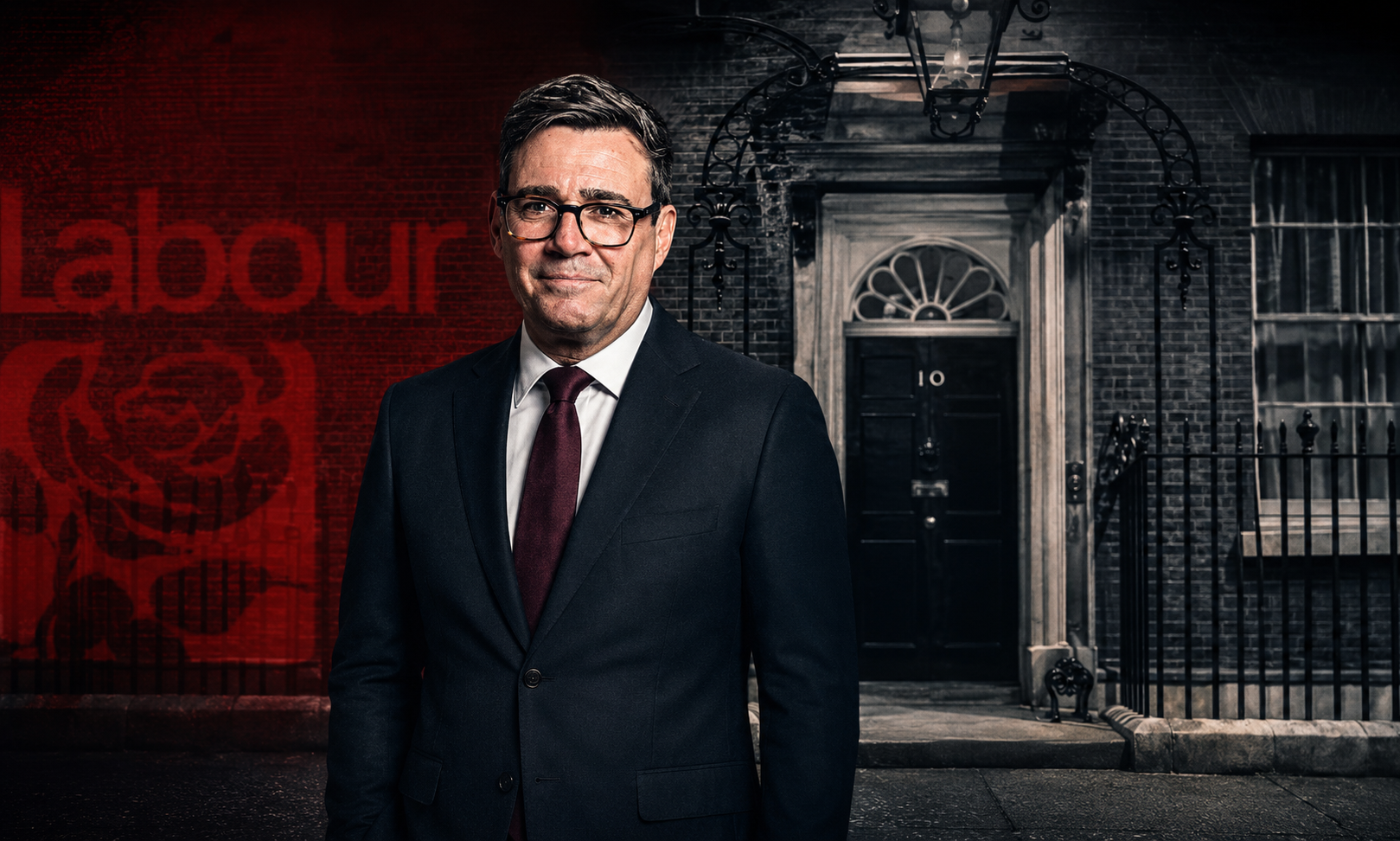
Andy Burnham became prime minister on 20 July 2026. Since then he has confirmed £2 bus fares from January 2027 and 24/7 bus passes for disabled people from April 2027. Liverpool has become the second English region to bring buses back under public control. His Bee Network model is now national policy, and that reaches every council funding local travel.
Key Takeaways
- Andy Burnham became prime minister on 20 July 2026. Two days later he announced a £2 cap on single bus fares in England outside London from 1 January 2027.
- Disabled bus pass time restrictions end on 1 April 2027, giving around one million people in England free travel at any hour, backed by £60 million.
- His record rests on the Bee Network, which returned Greater Manchester buses to local control for the first time in almost 40 years. Bev Craig was elected mayor on 31 July and now runs it.
- Franchising is spreading. Liverpool City Region brought its first buses back under public control on 6 September 2026, becoming the second English area outside London to franchise.
- A new accountability framework began in April 2026, so community transport, dial a ride and DRT schemes now need clean booking and reporting data to make their case.
Andy Burnham transport policy has stopped being a Greater Manchester story. It is now a national one. The mayor who rebuilt local buses has taken that thinking into Downing Street, and it will shape funding, franchising and the structure of public transport across England.
For anyone running or funding local transport, this matters. Burnham spent almost a decade arguing that buses, trams, rail, cycling and community services work best when planned together. He now holds the budget and the legislation needed to test that argument at national scale.
Is Andy Burnham prime minister?
Yes. Andy Burnham became prime minister on 20 July 2026, succeeding Keir Starmer. He won the Makerfield by-election in June 2026, which returned him to Parliament, then took the Labour leadership unopposed. He is the seventh prime minister in a decade.
He kept Heidi Alexander as Transport Secretary, a post she has held since November 2024. She served as Deputy Mayor of London for Transport between 2018 and 2021, so she understands a franchised network from the inside. That continuity is a signal in itself.
Louise Haigh, herself a former Transport Secretary, became First Secretary of State and Minister for the Cabinet Office. Burnham also opened a second office, No. 10 North, in Manchester. Two figures with transport backgrounds now sit at the centre of government.
What is the Andy Burnham transport plan?
The Andy Burnham transport plan centres on three things: greater local control, integration between modes, and lower fares. It is the Bee Network argument applied nationally. The first measures arrived within days of him entering Downing Street.
On 22 July 2026 the government confirmed that single bus fares in England outside London will be capped at £2 from 1 January 2027, running to the end of that year (GOV.UK). That cuts the maximum single fare by roughly a third.
Fares stay capped at £3 until the end of 2026. The previous plan had held £3 until the end of March 2027, so the change both lowers the cap and removes a spring increase. The wider package matters as much as the headline:
- £454 million of extra funding, including money for the devolved governments, drawn from a reprioritisation of the energy department's budget.
- More than £1 billion a year committed to bus services for three years, with over £3 billion flowing through the Local Authority Bus Grant between 2026 and 2029.
- Support for six mayoral authorities setting up bus franchising.
- A consultation on giving mayors the final say over public transport decisions, including mass transit.
Free travel for children ran through August 2026
The first measure to reach passengers was a summer scheme. Throughout August 2026, around 7.5 million children aged 5 to 15 in England travelled free on participating local buses, with unlimited journeys and no registration needed (GOV.UK).
The scheme was backed by £100 million and ended on 31 August. Child fares typically sit between £1 and £2, and under 5s already travel free with most operators. It followed a West of England pilot that recorded around 1.4 million free journeys. It has not been extended into the autumn term.
One lesson is worth carrying forward. Participation was voluntary and route by route, so school-only services, coach routes and some flexible services sat outside it. Many passengers assumed the scheme was universal. Expect the same confusion when the £2 cap changes in January.
Government points out that the earlier £2 cap drove an estimated 30 million extra bus journeys in 10 months. It also accepts that rural and coastal links remain insufficient, and that without a cap some single fares could climb above £10.
Operators have welcomed the focus while asking for stability. The Confederation of Passenger Transport has called for a long-term strategy and a fair reimbursement model for every operator taking part, now the cap is entering its fifth year (routeone).
Disabled bus pass restrictions end in April 2027
This is the measure with the widest reach for accessible transport. On 18 August 2026 the prime minister announced that time restrictions on disabled concessionary bus passes will be lifted across England from 1 April 2027 (GOV.UK).
Disabled passes currently work between 9.30am and 11pm on weekdays, unless a council chooses to fund an extension. From April 2027 eligible holders can travel free at any hour. Around one million people are expected to benefit, backed by £60 million of funding.
Two details matter for planning. The change applies to disabled passes, not older people's passes, which keep the existing hours. And the current concession stays in place until 31 March 2027, so nothing changes for passengers this year or next winter.
The government frames it as ending a postcode lottery. Councils that already fund early travel have been doing so at their own expense, creating inconsistency between neighbouring areas. Greater Manchester lifted its restrictions in March 2026, so this is the Bee Network approach applied nationally.
The practical effect is about access to work and healthcare. A 9.30am restriction rules out most early shifts, college starts and morning hospital appointments. Removing it changes what a disabled passenger can realistically commit to, which is a different kind of gain from a fare cut.
Why does Andy Burnham's transport record matter?
It matters because transport is the policy he is best known for, and he now runs the country. His reputation was built in Greater Manchester, where he served as mayor from 2017. Public transport sat at the centre of almost everything he did there.
Analysts at Centre for Cities note that his public transport policies carry more local recognition than those of any other English city leader, London included. They also point out that franchising in Greater Manchester took eight years from decision to completion.
That second point is the useful one. He has a track record of finishing long transport projects, much of it in untested territory. Anyone expecting fast national change should read the Greater Manchester timeline first. Franchising there was announced, assessed, consulted on and legally challenged before a single yellow bus ran.
Voters rated the result. YouGov polling of 2,200 Greater Manchester adults found 66% thought Burnham did a good job as mayor, including 55% of the region's 2024 Conservative voters. That is unusually broad approval for a transport record.
What is the Bee Network and how did bus franchising work?
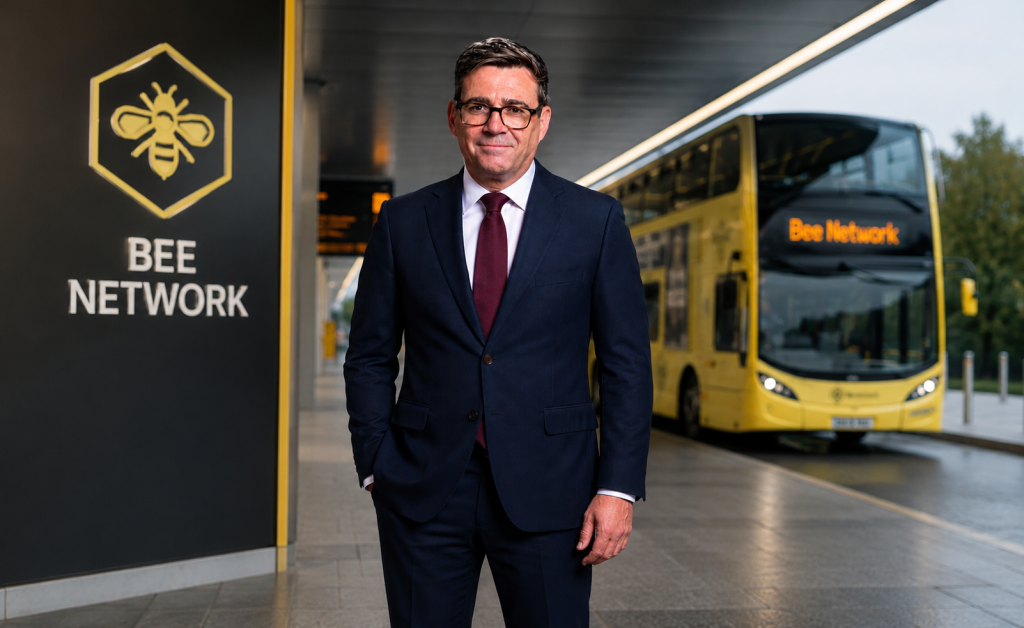
The Bee Network is Greater Manchester's integrated transport brand. It brings buses, trams and cycling under one system, with capped fares, shared branding and a single app. Local rail joins from December 2026. Its foundation was bus franchising.
Under franchising, the local authority sets routes, frequencies, fares and standards, then contracts operators to run the services. That replaces a deregulated market where commercial operators made those decisions. Buses were deregulated across Great Britain in 1986, and Greater Manchester bus use roughly halved in the decades that followed.
Greater Manchester introduced a £2 adult and £1 child single fare cap in September 2022. The first franchised services launched in September 2023 in Bolton, Wigan and parts of Bury, Manchester and Salford. Two further phases followed, with full local control arriving on 5 January 2025.
It was the first area outside London to bring buses back under local control in almost 40 years. The Greater Manchester Combined Authority reports the numbers behind it:
- 577 routes and 1,600 buses carrying more than 160 million trips a year came under local control.
- Franchising was delivered on time and on budget, with the cost of running services reduced by a third compared with intervening in the deregulated market.
- The £2 cap cut the average cost of travel by almost 20% and produced 5% patronage growth.
Bus journeys rose 14% year on year in the first franchising areas, according to Transport for Greater Manchester. Punctuality across the network reached 75.8% in March 2025, against roughly 66% in the first area before franchising.
Passenger satisfaction rose too, and around 84% of residents now sit within a five minute walk of a half hourly weekday service, up from 78% in November 2022. The target is 30% patronage growth by 2030.
One quieter change deserves attention. From 1 March 2026 Greater Manchester lifted the weekday 9.30am restriction on concessionary travel, so eligible older and disabled pass holders can use local buses at any time of day. That local decision has now become national policy for disabled passes from April 2027.
Who runs the Bee Network now?
Bev Craig. Burnham's win in Makerfield ended his time as mayor, because Greater Manchester's mayor also oversees policing and the rules prevent one person holding both roles. Paul Dennett, Mayor of Salford, served as acting mayor until the by-election.
Craig was elected on 31 July 2026. The Labour and Co-operative candidate, who has led Manchester City Council since 2021, took 309,525 votes once second preferences were counted, ahead of Reform UK's Sian Astley on 157,178, according to ITV News.
The contest went to a second round after neither candidate cleared 50% of first preferences. Turnout was 25.14%, with 538,659 votes cast from an electorate of 2,142,779, down from 32.05% in 2024 (Greater Manchester Elects). She serves until May 2028.
What has the new mayor done on transport?
She moved immediately. On her first official day, 3 August 2026, Craig announced an extension of the Our Pass scheme to 11 to 16 year olds, giving free Bee Network bus travel from January 2027. Combined with existing coverage, that reaches everyone aged 11 to 18.
The extension is expected to benefit nearly 200,000 young people and save families up to £500 per child each year, with applications opening later this year (Bus & Coach Buyer). Our Pass launched in 2019 and currently serves more than 50,000 young people.
Two further commitments matter for anyone working with vulnerable passengers. Free travel to school for children living in temporary accommodation starts in September 2026, administered by councils. New Bee Network services and route improvements also begin from September.
Craig's manifesto went further, promising to freeze Bee Network bus and Metrolink fares beyond December and to extend Metrolink towards Stockport. The pattern is continuity with acceleration, and it gives councils elsewhere a working example of what a mayor can do quickly.
How far could franchising and devolution go?
It is already going further than most people realise. The Bus Services Act 2025 received Royal Assent on 27 October 2025. A statutory instrument in force from 18 December 2025 gave franchising powers to all types of local transport authority in England outside London.
The Act also lifted the ban on councils running their own bus companies. Department for Transport guidance is clear that franchising is entirely a local decision, and that reorganisation of local government may affect timing and governance.
That is no longer theory. On 6 September 2026, Liverpool City Region became the second English area outside London to franchise, when St Helens bus services returned to public control for the first time in more than 40 years (GOV.UK).
Passengers saw changes from day one. Two hourly routes became hourly, evening and weekend timetables expanded, and a new X3 express links St Helens to Liverpool John Lennon Airport. A new low-emission fleet arrived with air conditioning, USB charging, audio-visual announcements and more space for wheelchairs and prams.
Stagecoach runs the St Helens network and Go-Ahead takes Wirral, which joins in October 2026. Liverpool, Knowsley and Sefton follow by the end of 2027. Around 70% of local people backed franchising at consultation, and buses account for 82% of public transport journeys in the region.
One detail caught passengers out. Operator-only Arriva and Stagecoach tickets stopped being valid on most St Helens services from launch day. Ticketing changes are the part of franchising that reaches passengers fastest, and the part front line staff field most questions about.
The West Midlands is moving too. In August 2026 the government committed £11.5 million over three years to protect services after National Express's parent company signalled it was leaving the market. The deal safeguards around 4,800 jobs and up to 750 buses a day while the region moves towards franchising.
West Yorkshire and South Yorkshire are also progressing. The House of Commons Library tracks progress across England, and the direction is now clear: franchising has stopped being a Greater Manchester experiment and become a rollout.
The bigger structural change is easy to miss. The English Devolution and Community Empowerment Act 2026 received Royal Assent on 29 April 2026. It creates a new tier of Strategic Authorities, sorted into foundation, mayoral and established mayoral categories.
Transport and infrastructure is a named area of competence. Mayors gain control of local transport plans and key route networks. Established mayoral authorities receive multi-year integrated funding settlements and a right to request changes to law and funding where it helps them deliver.
The Urban Transport Group describes this as a shift from ad hoc arrangements to a coherent, long-term approach. Put simply, the architecture Burnham needs to scale his model nationally was passed before he took office.
What is happening with rail?
Rail is moving on a parallel track, and it will reshape integration. The Railways Bill would create Great British Railways, a publicly owned body bringing infrastructure and passenger services together, setting fares and managing the network as one organisation.
The bill had its second reading in the House of Lords on 7 July 2026. Committee stage is expected in September 2026, with Royal Assent targeted by the end of the year and Great British Railways due to be established in summer 2027.
Nine passenger operators are already in public ownership under earlier legislation. The House of Lords Library notes the bill would also strengthen the Passengers' Council, letting it investigate complaints, enforce improvement plans and set service standards.
For local transport, the significant part is devolution. The bill hands mayors a greater role in specifying rail services in their areas. Greater Manchester brings its first rail lines into the Bee Network in December 2026, with eight commuter lines and tap and go planned by 2028.
What does the agenda mean beyond the big cities?

This is where it gets harder. The economic case for integration is strongest in dense urban areas. Centre for Cities found that just 40% of big city residents in the UK can reach their city centre within a 30 minute public transport journey, against two-thirds in comparable European cities.
Closing that gap in England's six largest cities outside London would give an estimated 1.2 million more people an easy 30 minute journey to a major centre. Poor connectivity is thought to cost the UK economy more than £23 billion a year.
Those are city numbers. Outer district centres, coastal towns, villages and estates between towns see far less benefit. Lower demand means higher subsidy per journey, which is exactly where a commercial market has always pulled back. Frequent buses need volumes thinly populated areas cannot supply.
A plan that only lifts city centres would leave the communities with fewest options no better off. That gap runs through SEND transport, home to school routes, patient transport and rural travel. It is also where the Bee Network itself has drawn criticism.
Where do community transport, dial a ride and DRT fit in?
They fit precisely into the gap a franchised bus map leaves behind. Community transport, dial a ride schemes, volunteer driver networks and demand responsive transport serve journeys scheduled routes cannot reach. A timetable cannot solve a trip that starts at a front door and ends at a clinic.
Think hospital trips, day centre runs, shopping rounds and door to door travel for people with limited mobility. For many passengers these are not a supplement to the bus network. They are the only option. Carers and family members plan their own week around whether that transport turns up.
Policy is starting to recognise this. The Bus Services Act 2025 requires local authorities to keep a list of socially necessary services under review. DfT guidance expects that list to include flexible services in rural areas in many places.
The same guidance is explicit that demand responsive services should be accessible, and that councils must meet their Public Sector Equality Duty when deciding provision. That is a direct concern for SEND transport leads, NHS transport teams and anyone arranging sensitive transfers.
The evidence base is building. In East Sussex, 87% of rural residents now sit within a 30 minute bus or Flexibus ride of their nearest GP surgery. Without Flexibus that figure would be 44%. The scheme returned a benefit to cost ratio of 3.02.
There is a practical point too. Community transport operators already appear in the national fare cap lists alongside commercial firms. Fare changes reach them directly, so reimbursement and eligibility records need to be right well before January 2027.
The April 2027 concessionary change adds to that. Early morning demand from disabled passengers is likely to rise once the 9.30am barrier goes, and some of those journeys will land with flexible services rather than fixed routes. Schemes that understand their current early demand will plan the change better.
This is the work our community transport software supports every day. Road XS helps operators, dial a ride coordinators and demand responsive providers manage bookings, drivers, vehicles and reporting in one place, making it easier for smaller schemes to meet rising expectations.
What new reporting will operators and councils face?
More than most people expect, and this is the part that gets overlooked. From April 2026 a new accountability framework applies to every local transport authority in England, built around a common set of indicators measuring performance against funding objectives (GOV.UK).
The indicators cover passenger satisfaction, punctuality, reliability, accessibility and safety. They mirror frameworks already running in Greater Manchester and the West Midlands. In other words, the Bee Network model of measurement is spreading alongside the funding.
Funding is changing shape at the same time. From 1 April 2026 the Local Authority Bus Grant consolidated most previous DfT bus grants into one needs-based allocation. The Bus Service Operators Grant continues, and it is paid to community operators as well as commercial ones.
Greater Manchester shows where this leads. Its franchised contracts tie what operators get paid to punctuality, reliability and complaint levels. Evidence becomes the currency. Schemes that cannot produce it will struggle to argue their case, however valued locally and however long they have run.
How can transport operators and councils prepare?
The direction is clearer than the detail, so get the fundamentals in order. Integration rewards anyone who can share clean data, prove performance and connect to wider networks. That applies to charities, councils, NHS teams and commercial operators alike.
- Get your data in order. Accurate records of routes, journeys, passengers and vehicles are the raw material of any franchised or integrated system.
- Make reporting routine. Trustees, boards and funders now expect evidence on punctuality, demand and outcomes. Reporting should fall out of daily work, not become a quarterly scramble.
- Evidence your socially necessary services. If a route belongs on a council's list, the case rests on passenger numbers, journey purpose and the absence of alternatives.
- Plan for integration. Bookable and flexible services need to sit alongside timetabled networks, so choose tools that flex rather than lock you in.
- Protect accessibility. Concessionary and free travel for older and disabled passengers sits at the heart of this model, so keep eligibility and accessibility data current.
- Brief your drivers and volunteers. Fare changes, new ticketing and revised eligibility land first with the people at the wheel and the passengers in front of them.
Whatever the final shape of national policy, the Bee Network has already changed the debate. The real test is whether an integrated system can reach past the city centre, into the villages, estates and door to door journeys that depend on flexible, human scale transport.
Andy Burnham transport: frequently asked questions

Is Andy Burnham prime minister?
Yes. Andy Burnham became prime minister on 20 July 2026, succeeding Keir Starmer, after winning the Makerfield by-election in June 2026 and taking the Labour leadership unopposed. He is the seventh UK prime minister in a decade.
What is the Andy Burnham transport plan?
The Andy Burnham transport plan centres on local control of public transport, integration across modes and lower fares. Confirmed measures include a £2 cap on single bus fares in England outside London from January 2027, 24/7 disabled bus passes from April 2027, and support for mayoral authorities setting up franchising.
Who is the Mayor of Greater Manchester now?
Bev Craig, leader of Manchester City Council since 2021, was elected Mayor of Greater Manchester on 31 July 2026. She won 309,525 votes after second preferences, beating Reform UK's Sian Astley on 157,178. She succeeds Andy Burnham and serves until May 2028.
When will bus fares fall to £2?
The £2 cap on single fares applies from 1 January 2027 until the end of that year, on participating services in England outside London. The existing £3 cap continues until the end of 2026. Fares in London are capped separately.
When do disabled bus pass time restrictions end?
On 1 April 2027. From that date, eligible disabled bus pass holders in England can travel free at any time of day, removing the current weekday limit of 9.30am to 11pm. Around one million people benefit. Older people's passes are unaffected and keep the existing hours.
Which areas of England have bus franchising?
Greater Manchester completed franchising in January 2025. Liverpool City Region began on 6 September 2026 in St Helens, with Wirral in October 2026 and the rest of the region by the end of 2027. West Midlands, West Yorkshire and South Yorkshire are progressing.
What is the Bee Network?
The Bee Network is Greater Manchester's integrated transport system. It joins buses, trams, cycling and, from December 2026, local rail under one brand, with capped fares, shared branding and a single app for planning and paying.
What is bus franchising?
Bus franchising is a model where a local transport authority sets routes, frequencies, fares and standards, then contracts operators to run the services. It replaces a deregulated market in which commercial operators made those decisions themselves.
Can other areas copy the Bee Network?
Yes, and some already are. The Bus Services Act 2025 extended franchising powers to all local transport authorities in England outside London and lifted the ban on councils running bus companies. Liverpool City Region became the second area to franchise in September 2026, following Greater Manchester.
What does this mean for community transport and DRT operators?
It points to more local control, integration and measurement. Councils must now keep socially necessary services under review, and a national accountability framework began in April 2026. Operators with clean data, straightforward reporting and flexible booking will be best placed.
Ready to get your transport data ready for what comes next?
Road XS helps community transport schemes, councils, charities and NHS transport teams manage bookings, drivers, vehicles and reporting in one place. Speak to our team, or take a closer look at how the software works.